
What gets measured gets managed.
There are dozens of things you could measure in diabetes. The problem is that measuring ten different metrics at once is a fast track to burnout.
So we’re keeping this simple. Focus on three measures that tell you almost everything you need to know:
- Percentage time in range (4.0–10.0 mmol/L or 70–180 mg/dL)
- HbA1c (mmol/mol or %)
- Total daily insulin dose (units per kilogram, U/kg) — see “What type of T1D do you have?”
1) Time in range (4.0–10.0 mmol/L or 70–180 mg/dL)
You already know this measure well — I’ve been banging on about it since page one. Here’s the current international consensus on glucose targets. There’s more detail and the evidence base in For John – Research.
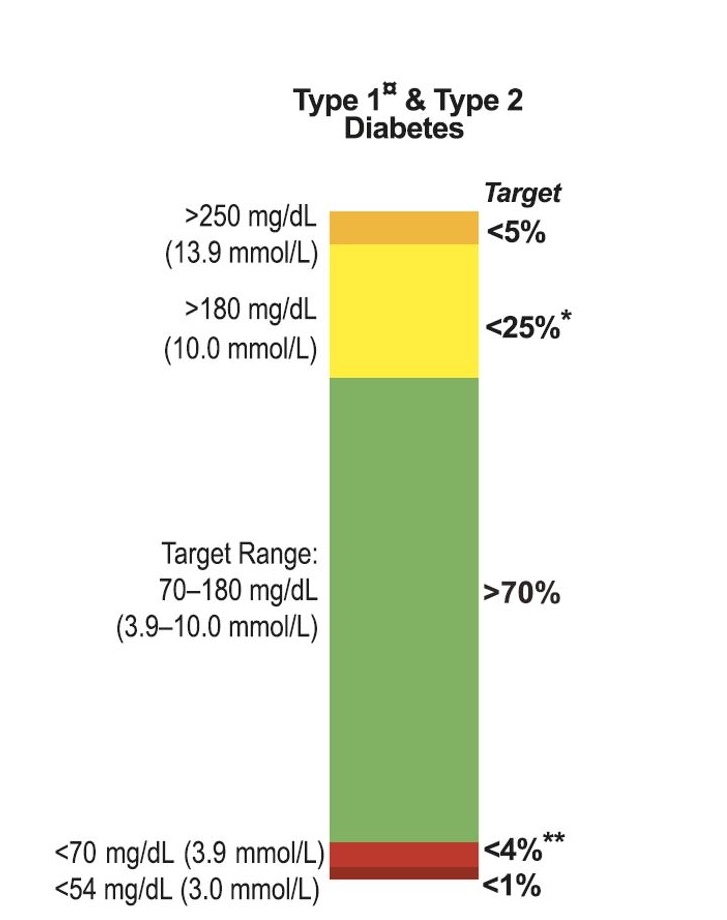
Aim for 70% time in range as your first milestone. That’s a solid, realistic starting point.
But with Dynamic Glucose Management, 70% is the basement. We’re heading for the penthouse.
I made a table to help you decide where you want to land based on what you’re willing to trade in effort and attention. Pick a target that feels challenging but sustainable.
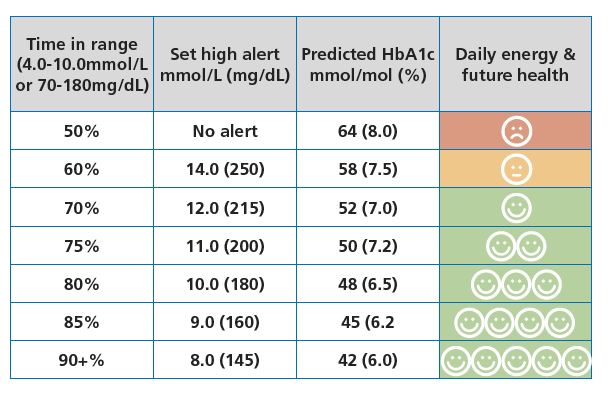
The catch: to hit a higher time in range, you must set your high alarm accordingly and use GAME (the stop-highs strategy) to get there.
Don’t sprint out of the gates. Improve by ~5% every couple of weeks. Rome wasn’t built in a day and neither is a 90%+ TIR life.
2) HbA1c (mmol/mol or %)
HbA1c measures how much glucose has become attached to your red blood cells. Higher HbA1c = higher average glucose over roughly the last 3 months.
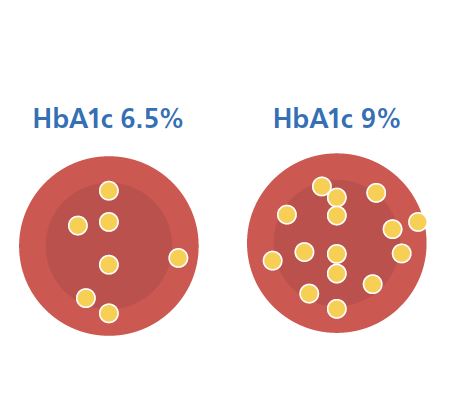
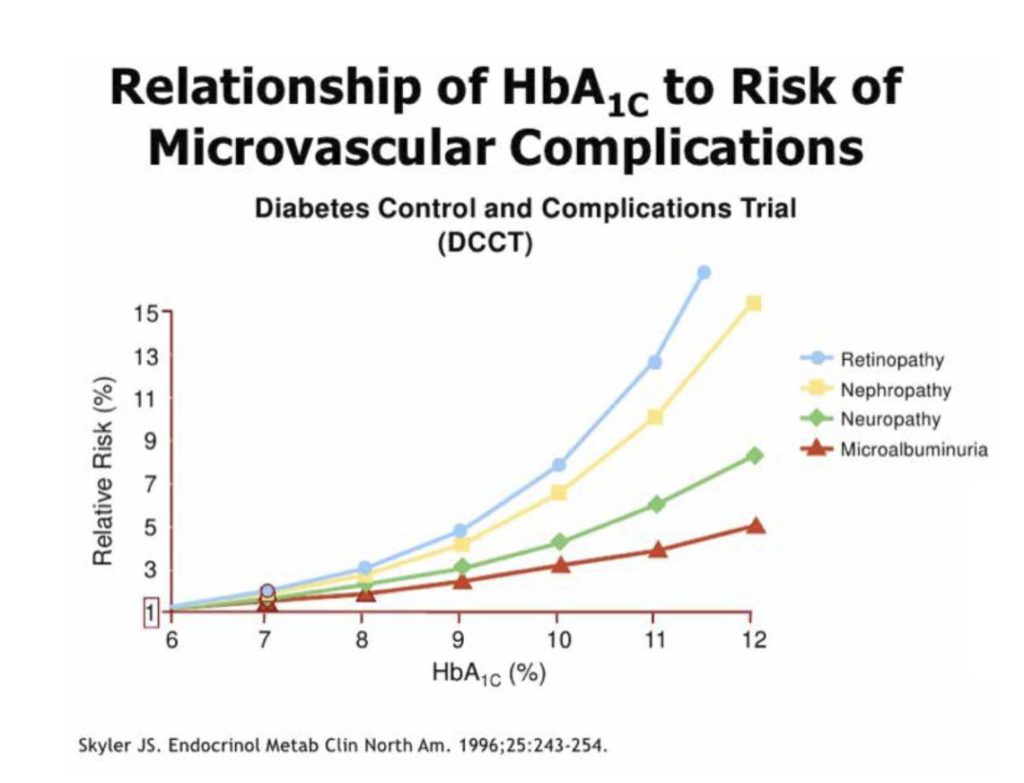
Think of HbA1c like a crystal ball: it predicts future risk. The landmark DCCT trial showed that the risk of microvascular complications climbs steadily as HbA1c rises.
A good headline goal is HbA1c ≤ 48 mmol/mol (6.5%). If you keep time in range above ~80%, this becomes very likely.
Important caveat: in some people, especially those with darker skin tone or certain haemoglobin variants, HbA1c can run higher (or lower) than time in range would predict. If that’s you, read this explanation on why the relationship isn’t always straightforward.
3) Total daily insulin dose (U/kg)
Total daily dose tells you a lot about insulin sensitivity and underlying resistance. The adult range is broad: roughly 0.4 to 1.0 U/kg, and in some cases up to 2.0 U/kg.
Examples:
A 75 kg male often needs 30–75 units/day (upper end ~150). A 60 kg female often needs 24–60 units/day (upper end ~120).
- 0.4–0.5 U/kg → Insulin sensitive (~10% of people with T1D)
- 0.5–0.7 U/kg → Some insulin resistance (~30%)
- 0.7–1.0 U/kg → Significant insulin resistance (~50%)
- >1.0 U/kg → High insulin resistance (~10%)
For children aged 1–12, the same dose range applies (0.4–1.0 U/kg). During puberty (roughly 12–18), insulin needs often rise due to hormonal changes. See the data here.
- 0.4–0.6 U/kg → Insulin sensitive (~10%)
- 0.6–0.8 U/kg → Resistance emerging (~30%)
- 0.8–1.2 U/kg → Significant resistance (~50%)
- >1.2 U/kg → High resistance (~10%)
If you’ve just read that and thought “OMFG” — breathe. You’re not broken. You’re in the majority. For a proper breakdown and practical fixes, go to the Insulin Resistance for T1D guide.
Using 0.4 U/kg is like aiming for 90%+ time in range: aspirational. The smart play is to improve from where you are now.
- If you’re currently >1.0 U/kg, think of that like 40% time in range. Moving to <1.0 U/kg is a big win.
- If you’re around 0.7 U/kg, that’s like 60% time in range. Dropping to 0.6 U/kg (and holding glucose steady) is serious progress.
Run your race — one you can actually win.
Essential point: don’t sacrifice glucose control just to reduce insulin. Lower insulin with higher glucose is a terrible trade. Improving sensitivity only matters if you maintain (or improve) control. Don’t rob Peter to pay Paul.
If insulin resistance is your main barrier, this guide will help you get on top of it: Overcoming insulin resistance in T1D.
Congratulations. You’ve laid strong foundations.
You’re now ready for the game-changer.
Next step: Dynamic Glucose Management