
The GNL Podcast
Episode 23, from diabetes brunches to Bali
A table laid for nine, a stack of pancakes, and a room of strangers who all happen to carry the same condition. By the end of the morning nobody is a stranger any more. One conversation turned into one coffee, one coffee turned into one brunch, and a young doctor who was diagnosed at seventeen had quietly built the thing she had needed all along.
Ask Grace
Want to understand how sharing real CGM patterns in a group can replace shame with solidarity, and what the evidence says about peer support in type 1 diabetes?
Listen or watch
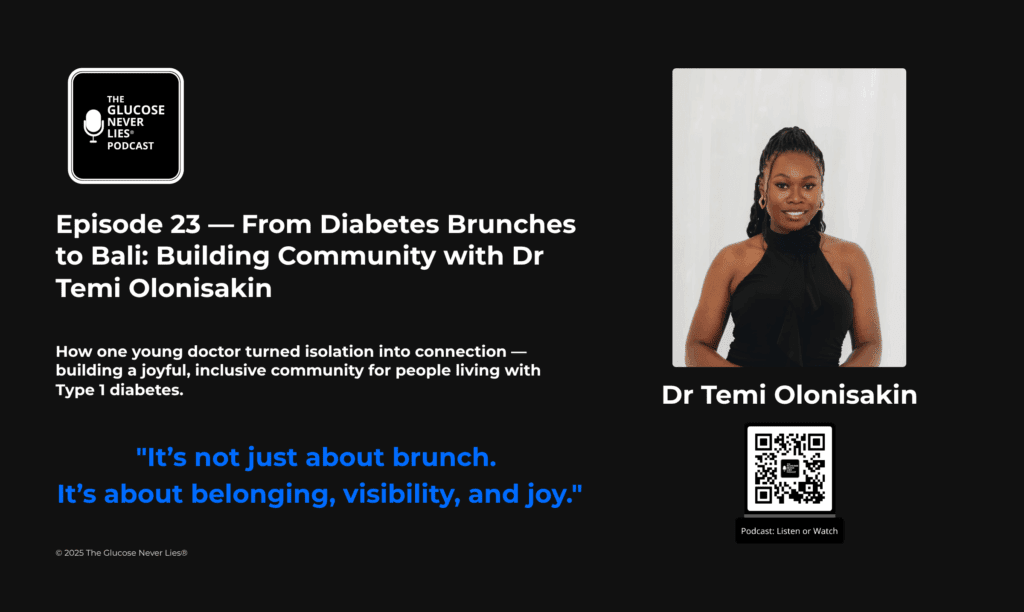
Available on Spotify, Apple Podcasts, Buzzsprout, and YouTube. Guest: Dr Temi Olonisakin, creator of Diabetes Brunch Live. Host: John Pemberton. This episode represents the independent views of the speaker and the host.
Why this episode exists
If you live with type 1 diabetes, you already know that the loneliest part is rarely the clinic. It is the everyday moment nobody else in the room understands: the silent pre-meal calculation, the alarm that goes off mid-conversation, the times your glucose misbehaves for no reason you can name. Most people learn to manage the condition long before they find anyone who simply gets it.
Dr Temi Olonisakin was diagnosed at seventeen, the age when independence is meant to begin and diabetes arrives to complicate it. Years later she began bringing people together, from one-to-one coffees to full-scale Diabetes Brunch Live events, mixing friendship, advocacy, and education with a healthy side of pancakes. This episode is about what that connection does: how seeing people like yourself changes everything, and why joy turns out to be the door that learning walks through.
In this episode
Dr Temi Olonisakin joins The Glucose Never Lies® Podcast to share how lived experience, openness, and representation can spark community and confidence in type 1 diabetes. Diagnosed at 17, Temi knows first-hand the isolation that comes when diabetes arrives just as independence begins. Years later, she began bringing people together, from one-to-one coffees to full-scale Diabetes Brunch Live events, growing from nine people to more than 26 live events. It is not about brunch. It is about belonging, visibility, and joy.
John and Temi cover the difficult age of diagnosis, why representation equals safety, how community normalises variable glucose, and the dream of Brunch Abroad: connection that travels. Say hello on Instagram: @temidiabeticdoctor.
Episode chapters
- 00:00, Diagnosed at 17, the lonely years
- 05:30, First coffees to first brunch
- 12:20, From 9 to 26, growth and facilitation
- 16:40, Bottomless brunches and normalising glucose variability
- 21:30, Brunch Abroad dreams
- 24:30, Beyond London, plans for the North
- 25:50, Doctoring and sustainable work
- 31:20, Advocacy wins, getting the right technology
- 38:30, Representation and equity
- 45:40, What services for teenagers miss
- 47:50, Wrap-up and reflections
Watch or listen
Key themes
The difficult age needs special care
Adolescence collides with diagnosis. The years from 14 to 18 are the hardest age for independence and self-management, and young people tend to thrive in fun, peer-led spaces rather than formal education settings. Temi’s own diagnosis at 17 sits squarely in that window, and much of what she has built since speaks directly to what services for teenagers tend to miss.
Start small, then grow
One conversation, one brunch, one community. Diabetes Brunch began with nine people and grew to more than 26 live events, and the growth was not a marketing strategy. Authenticity scales naturally: choose a format people already enjoy, invite six to ten people first, set the tone early as judgement-free with laughter encouraged, and keep the conversation alive between meet-ups through a WhatsApp group and regular gatherings.
Fun beats formality
Joy opens the door to learning. Brunch works because it feels human, and because value arrives sideways: a quick tip on clinics, a note on technology, a shared piece of self-care, offered between mouthfuls rather than across a desk. The format people already enjoy, brunch, coffee, Pilates and pastries, becomes the carrier for the education.
Representation equals safety
People attend when they can see themselves, across ethnicity, gender, body size, and culture. Seeing people like yourself changes everything, and building diversity deliberately is what makes a space feel safe enough to walk into. This is the equity argument made plain: representation is not decoration, it is the condition for showing up at all.
Community normalises variable glucose
Sharing CGM patterns replaces shame with solidarity. Post-brunch reflections on real glucose traces let people see that variability is ordinary rather than a personal failure, and that recognition does quiet, durable work that no leaflet manages. The condition stops being something to hide and becomes something held in common.
Advocacy is learnable
Advocacy is not a personality trait reserved for the confident; it is a set of moves anyone can pick up. You can switch hospitals via a GP referral. You can request technology that fits your life. Turning frustration with care into practical action is one of the threads running through Temi’s story, and one of the episode’s clearest take-homes.
Intimacy or scale, rarely both at once. The thing that makes a brunch work, the small judgement-free room where everyone is seen, is the same thing that resists growing. Temi’s answer is not to choose one over the other but to redesign as the group grows: once the group passes twenty, add co-hosts or table leads so the room can get bigger without losing the closeness that made it worth attending. Scale costs intimacy unless you build for it on purpose.
Words matter
Replacing “good” and “bad” with clear, compassionate language builds confidence. The way glucose, effort, and outcomes are described shapes whether a person feels capable or judged, which is why the same care that goes into the food and the welcome goes into the language too.
Practical exploration
For people living with type 1 diabetes and their families
Temi’s story is an invitation rather than an instruction. The encouragement is to find, or make, the room you have been missing.
- Connection can start very small. One conversation or one coffee with someone who shares the condition is a beginning, and it does not need to be a formal event to count.
- Seeing people like yourself, across ethnicity, gender, body size, and culture, is part of what makes a space feel safe. If a group does not reflect you, that is worth naming rather than tolerating.
- Sharing real glucose patterns with people who understand can ease the shame that often travels with variability. You are allowed to find your numbers ordinary.
- Advocacy is learnable. You can ask about switching hospitals through a GP referral, and you can ask for technology that fits your life. Knowing these doors exist is the first step to walking through them.
For clinicians and educators
The episode is a gentle argument that peer-led, joyful spaces reach the people formal settings often miss, especially in the difficult adolescent years.
- Young people from 14 to 18 tend to engage more readily in fun, peer-led settings than in formal education. The format people already enjoy can carry the teaching.
- Representation is a safety feature, not a nicety. People attend when they can see themselves, so building diversity deliberately changes who shows up.
- Group settings can normalise variable glucose in a way one-to-one review struggles to, because solidarity does work that instruction does not.
- The language you use, “good” and “bad” in particular, shapes confidence. Clear, compassionate words are part of the care.
About the guest
Dr Temi Olonisakin is a doctor living with type 1 diabetes, diagnosed at 17, and the creator of Diabetes Brunch Live, a community that grew from nine people to more than 26 live events bringing people with type 1 diabetes together through friendship, advocacy, and education. She engages, listens, and challenges gently; her work centres belonging, visibility, and joy, with a deliberate emphasis on representation across ethnicity, gender, body size, and culture. Say hello on Instagram: @temidiabeticdoctor.
Related reading on GNL
Episode 23 of the GNL Podcast
From diabetes brunches to Bali
This content is for educational exploration only. It describes average responses and general principles. It is not medical advice and cannot replace individual clinical guidance from your diabetes care team.