
The GNL Podcast, Beyond the Numbers
Episode 26, Diabetes with Milly
A phone rings during the final year of a biology degree. The voice on the other end says get to hospital now, you are in severe DKA. The third UK lockdown means the diagnosis weekend is spent alone, with no visitors allowed. What grows out of that isolated start is the unexpected part: a community of people with type 1 diabetes that feels like home.
Ask Grace
Want to understand how strength training and yoga pull glucose in different directions, and why someone might keep both rather than choose?
Listen or watch
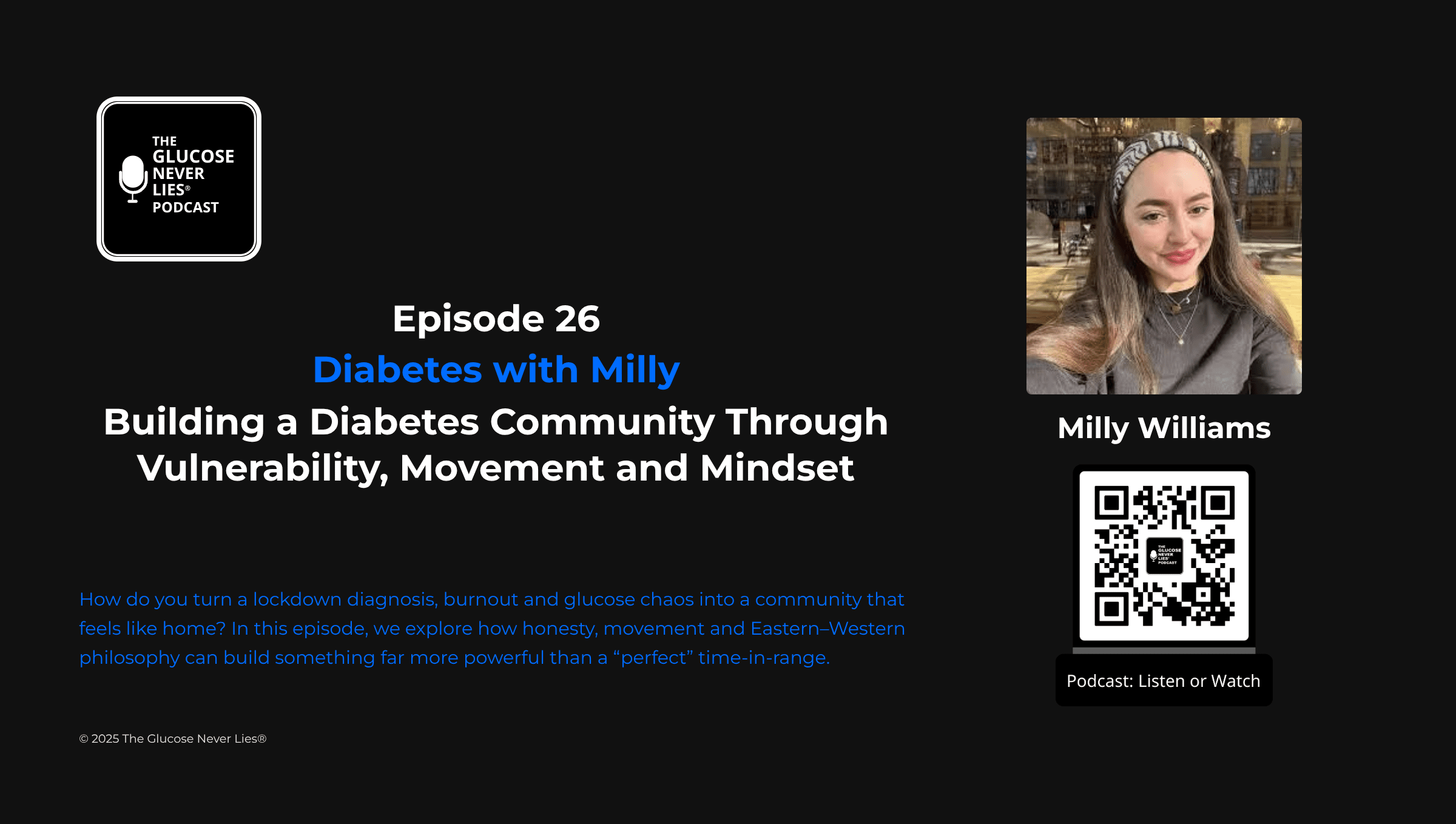
Available on Spotify, Apple Podcasts, Buzzsprout, and YouTube. Released 15 December 2025. Guest: Milly, the creator behind Diabetes with Milly. Host: John Pemberton. Director of Creativity: Anjanee Kohli.
Why this episode exists
If you live with type 1 diabetes, you already know how much of it happens between appointments. The clinic gives you the guidelines and the evidence, and then you go home and have to make all of it real, day after day, mostly on your own. The encouragement, the small wins, the reassurance that a frightening number is not a failure: those rarely come from a consultation room. They come from other people who are living the same thing.
This is a Beyond the Numbers episode, and it sits on a simple reflection that John keeps returning to: guidelines and evidence have limits, and real-life implementation needs peers as well as professionals. Online communities provide belonging, meaning and daily encouragement between appointments. Milly’s story is one route into how that community gets built, out of sport, yoga, Eastern philosophy and honest vulnerability.
In this episode
In this Beyond the Numbers episode, John speaks with Milly, the creator behind Diabetes with Milly, about how a lockdown diagnosis, sport, yoga, Eastern philosophy and honest vulnerability have combined into a community that feels like home for people with type 1 diabetes.
Diagnosed in January 2021 during the third UK lockdown, in the final year of her biology degree, Milly went from rapid unexplained weight loss and a racing heart to a phone call telling her she was in severe DKA and needed to get to hospital immediately. She spent her diagnosis weekend alone due to COVID restrictions, and then had to relearn how to move, train and live with type 1 from inside a family bubble.
Over time, her background in sport and strength training, a solo trip to India for intensive yoga, and a growing interest in women’s health and exercise physiology have all fed into a distinctive East-meets-West approach: resistance training for metabolic health, yoga and breathwork for nervous system regulation, and social media as a vehicle for real, day-to-day honesty.
Episode chapters
- 00:10, Why this podcast exists: lived experience and evidence
- 01:23, Milly’s diagnosis in lockdown: DKA, final-year exams and isolation
- 07:41, Sport, strength training and relearning movement after diagnosis
- 11:13, India, yoga and regulating the nervous system
- 14:46, Building Diabetes with Milly and the Glucose Gals community
- 28:15, Women’s health, menstrual cycles and her next research chapter
Watch or listen
Key themes
Diagnosis in lockdown: DKA, exams and isolation
Milly’s diagnosis arrived in the worst possible week to be alone. In the final year of a biology degree, with exams in front of her, the rapid weight loss and fatigue she had been pushing through turned out to be severe DKA. She was told over the phone to go straight to hospital, during COVID restrictions, and spent her diagnosis weekend with no visitors allowed. That isolation did not stay in the hospital; it shaped the confidence, fear and behaviour that came long after she was discharged.
Exercise as identity and therapy
Sport was already who Milly was: cricket for Lancashire, football in Wigan, then strength and hypertrophy training. After diagnosis, the first home workout brought the first frightening hypoglycaemic episode, and yet activity became a non-negotiable tool for both metabolic and mental health. Lockdown, for all its constraints, gave her something useful here, a safe environment to relearn movement with family close by.
East meets West: India, yoga and nervous system regulation
Two years after diagnosis, Milly travelled solo to India for 26 to 27 days of yoga training in an ashram. What she brought back was not a replacement for strength work but a companion to it: she describes blending the two, compacting versus lengthening muscles, and keeping both deliberately. Breathwork, mindfulness and body awareness became ways to manage anxiety during hypos, and Eastern practices helped her step back from frustration and the emotional echoes that can follow a high.
Burnout, back-burner diabetes and coming home
The honest part of the India story is that diabetes slipped to the back burner. Milly went from around 250 Libre scans and logging everything to disengaging during the final weeks of the trip, on a high-carb vegetarian diet, with multiple hours of yoga per day and a lost routine. Her response was not guilt but a decision: accept the imperfection, focus on the purpose of the trip, and rebuild structure and connection to her management once she returned home.
Social media, vulnerability and the growth of Diabetes with Milly
Two months after diagnosis, inspired by other T1D creators, Milly started her Instagram account. There was no strategy beyond documenting real life, and yet it grew organically to its first thousand followers. People began contacting her about exercise, nutrition and mindset, and a community formed around shared struggles. She chose Instagram over TikTok deliberately, to protect focus and depth.
Hypos, hypers and emotional responses
Yoga and logic-based self-talk helped Milly move from near-panic during hypos to more grounded responses. Interestingly, she finds highs can trigger stronger emotional reactions than lows, and diagnosis anniversaries can carry a quiet sense of “is this happening again?” Her instinct is to normalise these responses as human, not failures.
Women’s health, menstrual cycles and a new research path
Milly’s path runs from a biology degree to exercise physiology to PT and yoga instruction in the Lake District, and now towards research. She is drafting a new master’s proposal in women’s health and type 1 diabetes, with a particular interest in insulin and glucose responses across the menstrual cycle and across life stages. The longer vision is a PhD on physical activity in women with T1D.
Building community: Glucose Gals and offline aspirations
Out of the online connection came Glucose Gals, a WhatsApp community of around 250 women with type 1 diabetes, with sub-chats for pregnancy, exercise and other key topics. Milly dreams of UK meet-ups that blend training, yoga and practical peer support. Her underlying point is that being authentic and joyful makes connection possible, and does not make her less credible.
Beyond the numbers: why people need people
John closes on the reflection the series is named for. Guidelines and evidence matter, but clinic-based support has limits, and real-life implementation needs peers as well as professionals. Online communities are where belonging, meaning and daily encouragement live, in the long stretch between appointments.
The numbers matter, but they are not where people live. The conversation keeps landing on one tension: a condition managed largely between appointments cannot be carried by clinic support alone. Evidence and guidelines set the direction; peers and community supply the daily encouragement that makes following them sustainable. The trade-off the episode names is that neither replaces the other, and that the support people most rely on is often the part the system measures least.
Practical exploration
For people living with type 1 diabetes and their families
Milly’s story is less a set of instructions and more a set of permissions, worth holding alongside whatever your own care team advises.
- Movement can be both metabolic and mental-health support at once. If exercise feels frightening after diagnosis, relearning it somewhere safe, with people close by, is a reasonable thing to explore with your team.
- Strength training and yoga pull in different directions, and some people deliberately keep both. There is room to explore what each does for you rather than treating one as the right answer.
- Disengaging from numbers during an intense period is human. Accepting imperfection and rebuilding structure afterwards is part of the rhythm, not a moral failing.
- Highs can carry as much emotional weight as lows, and anniversaries can stir old fear. Naming those responses as normal is often more useful than trying to suppress them.
- A peer community can offer the encouragement that appointments cannot. Following honest creators, or finding a group like Glucose Gals, is one way to feel less alone with the daily work.
For clinicians and educators
The episode is a quiet reminder that the work continues long after the consultation ends, and that belonging is part of the outcome.
- The emotional aftermath of an isolated diagnosis can outlast the clinical recovery. Asking how someone felt around diagnosis, not just about their numbers since, can surface barriers that explain later behaviour.
- Exercise advice that acknowledges both the metabolic and the psychological role of movement is likely to land better than a glucose-only framing.
- Periods of disengagement happen, especially around travel and major life events. A non-judgemental plan to re-establish structure is more useful than treating the gap as a failure.
- Peer communities sit alongside clinical support, not in competition with it. Signposting trusted, honest community spaces can extend encouragement into the long stretch between appointments.
About Milly, Diabetes with Milly
Milly is a 25-year-old living with type 1 diabetes, diagnosed in 2021 during the third UK lockdown. She has a background in biology and exercise physiology, and now works as a personal trainer and yoga instructor in the Lake District. Her work blends strength and resistance training, yoga and mindfulness, evidence-informed thinking about exercise and metabolism, and honest conversations about burnout and mental health with T1D.
- Instagram: @diabeteswithmilly
- Glucose Gals: a WhatsApp community for women with T1D, send Milly a direct message on Instagram to join
Related reading on GNL
Episode 26 of the GNL Podcast
Diabetes with Milly
This content is for educational exploration only. It describes one person’s lived experience and general principles. It is not medical advice and cannot replace individual clinical guidance from your diabetes care team.