
The GNL Podcast
Episode 24, Skincare, Sensors and Smarter AID Algorithms
How to protect your skin and optimise Control-IQ, practical, evidence-based guidance from researcher and nurse Dr Laurel Messer.
Ask Grace
Want to ask about sensor adhesion, skin reactions, or Control-IQ settings? Ask Grace.
Listen or watch
Released Monday 17 November 2025
About the guest
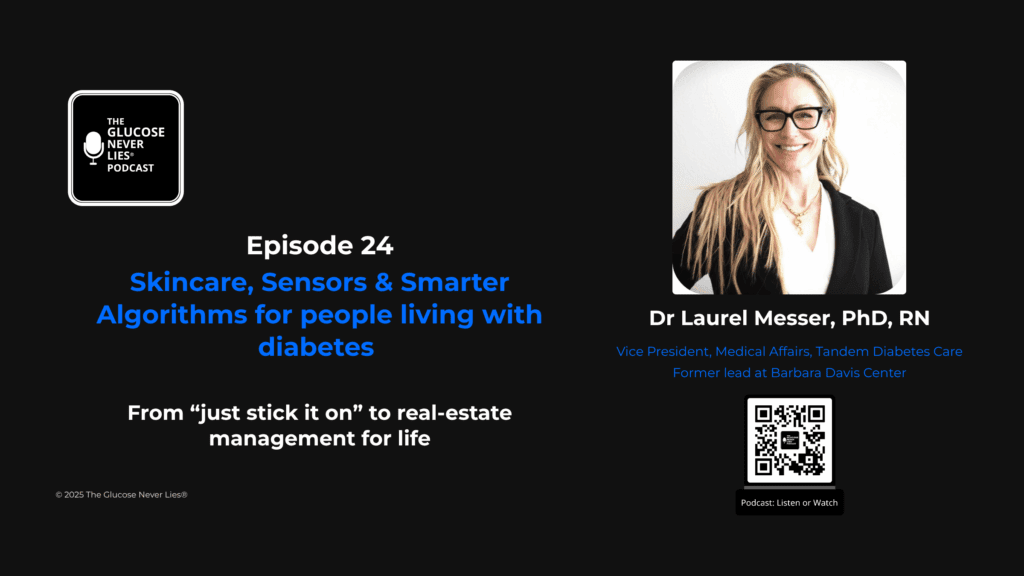
Dr Laurel Messer, PhD, RN
VP Medical Affairs, Tandem Diabetes Care
Nurse and Researcher, Barbara Davis Center
Founder, Panther Program
Author of multiple landmark skincare and AID studies
Your skin is not decoration, it is a piece of life-critical infrastructure. Every CGM reading and every unit of insulin depends on healthy, intact skin. This episode reframes device wear from “just stick it on” to intentional management of limited skin real estate.
Skincare for CGM and pump sites, FAQ (download)
What this episode covers
- Why device-related skin problems are common, predictable and preventable
- How to prepare the skin for reliable adhesion and healthier long-term outcomes
- How to distinguish irritation from allergy, and why that distinction matters
- The Soap-Water-Dry → Rotate → Low and Slow framework
- The hidden link between skin quality, CGM accuracy and insulin absorption
- Why Control-IQ performance hinges on one setting: the correction factor
- How to tune AID systems for children, teenagers, alcohol use and sick days
- What is coming next from Tandem: Control-IQ+, Mobi, patch-based wear options, Libre 3+
Skin as a limited resource
CGMs and pumps place continuous demands on fragile skin: strong adhesives, needles and introducers, moisture, sweat and occlusion, friction and mechanical shear, and consistent rotation requirements. For children, available skin surface area is very limited.
Most device-related problems fall into five categories:
1. Mechanical irritation
Caused by aggressive removal, friction or adhesive shear.
2. Chemical irritation
Due to adhesives, acrylates, sweat or improper preparation.
3. Allergic contact dermatitis
A rare but intense immune-driven reaction, reproducible, persistent and very itchy.
4. Lipohypertrophy or tissue damage
Particularly common with poorly rotated infusion sets.
5. Infection
Lower risk overall, but higher when the skin barrier breaks.
Up to 95% of problems are preventable with simple structure and good habits.
The three core prevention pillars
Dr Messer’s framework is intentionally simple, complexity kills adherence.
1. Preparation: Soap-Water-Dry
The single most important, and most commonly skipped, step.
2. Rotation: more sites than you think
Rotation prevents lipohypertrophy, scarring and tissue fatigue, reduced insulin absorption, sensor failures and early detachment.
General guidance: use 6-10 zones; rest each zone for at least one week; keep 1-2 inches away from recent sites; avoid bony areas, belts and friction zones. For children: arms, flanks, buttocks, upper thighs.
3. Removal: low and slow
Use baby oil, olive oil or adhesive removers such as Lift Plus, Uni-Solve, or TacAway. Support the skin with one hand, fold the adhesive back over itself, never pull upward, then cleanse and moisturise afterwards.
Barrier strategies
Barrier wipes (Cavilon or Skin-Tac) provide a thin protective film. Light films (IV3000 or Tegaderm) can be placed under CGM with a window cut for insertion. Hydrocolloids (Compeed) provide cushioning and moisture absorption.
Key principles: less is more, minimise layering; allow films to dry fully; thicker barriers reduce insertion depth, use caution with infusion sets.
For deeper adhesive science, see the World’s Finest AID session 5 with Dr Anna Berg.
Irritation versus allergy: a crucial distinction
Irritation
Redness, dryness, mild itch. Unpredictable onset. Improves with barriers and rotation.
Allergic contact dermatitis
Intense itch, blistering or vesicles, spreading inflammation. Reappears every time the adhesive is used, may take months to develop, and requires dermatology support.
Why skin quality affects CGM accuracy and AID performance
Poor skin integrity tends to produce noisy CGM signals, compression lows, early sensor degradation, unpredictable insulin absorption, and night-time variability. Skincare is not cosmetic, it is performance engineering.
Control-IQ: the correction factor
Dr Messer and Dr Marc Breton analysed data from over 20,000 users. They found that one setting matters most: the correction factor. It increases algorithm responsiveness, improves time-in-range, and does not increase hypoglycaemia risk compared with basal or carb-ratio changes. It can also be fine-tuned by time of day.
Time blocks: circadian tuning for real life
Different age groups follow predictable insulin-sensitivity rhythms.
Children under 5
A strong insulin-resistance spike tends to occur between 5-10 p.m., followed by much higher sensitivity overnight, the Dusk-then-Drop Phenomenon. The paediatric Part 1 (infants and preschoolers) covers the under-6 Dusk-Then-Drop pattern in depth, including per-system AID settings adjustments for Control-IQ, CamAPS FX, and Omnipod 5.
Teenagers and alcohol
AID systems may deliver more insulin if glucose is elevated. A dedicated profile with a relaxed correction factor and reduced basal is a commonly explored approach. The Partying with T1D guide and the alcohol and Control-IQ guide cover this in detail.
Sick days
Control-IQ+ allows temporary basal changes during automation, worth exploring with your care team.
Coming soon from Tandem Diabetes Care
Control-IQ+
- Temporary basal during automation
- Extended bolus up to 8 hours
- Official label expansion to age 2
Libre 3 Plus integration
- 15-day sensor
- 1-minute data
- Seamless Control-IQ compatibility
Tandem Mobi
- Smallest pump to date
- Fully phone-based
- Patch-based Mobi option in development
- Designed for lighter on-body footprint
Practical take-homes
- Skincare is diabetes care
- Follow the Soap-Water-Dry → Rotate → Low and Slow pillars
- Use 6-10 zones and rest each area for a week
- Distinguish irritation from allergy early
- Children need more deliberate skin protection
- If skin breaks down, rest that area until fully healed
Evidence supporting this episode
Skin integrity and adhesives
- Messer LH et al. Preserving skin integrity with chronic device use
- Berg AK et al. A skin care programme to prevent skin problems
AID systems and algorithm optimisation
- Correction factor is the key to Control-IQ (Messer and Breton)
- Consensus recommendations for AID systems (Phillip, Messer et al.)
- CARES paradigm for advanced devices (Messer et al.)
- Practical considerations for AID (Messer et al., 2025)
Behavioural and adolescent adoption
Related GNL resources
This content is for educational exploration only. It describes average responses and general principles. It is not medical advice and cannot replace individual clinical guidance from your diabetes care team.