
AID Systems Guide, CamAPS FX
CamAPS FX
CamAPS FX runs the Cambridge model predictive control algorithm, and it is the one system in this cluster that adapts to you over days and weeks rather than working from a fixed set of rules. The algorithm lives on an Android phone or iPhone, not on the pump, and runs on your choice of two tubed pumps, the YpsoPump or the Dana-i. The lever you reach for is your personal glucose target; the insulin-to-carbohydrate ratio sits behind it as a setting to get right rather than one to keep tuning. It carries the widest paediatric licence of any AID system, from age 1, and it was the first closed loop to be cleared for use in pregnancy.
Ask Grace
Want to work through your CamAPS FX boost, ease-off, and target choices? Ask Grace.
CamAPS FX at a glance
- Primary lever: your personal glucose target, adjustable across separate periods of the day from 4.4 to 11.0 mmol/L (80 to 200 mg/dL) in 0.1 mmol/L steps, default 5.8 mmol/L, the setting to steer control tighter or looser
- Secondary lever, handle with care: the insulin-to-carbohydrate ratio (ICR) is a secondary lever, not a direct input to the algorithm. Unlike 780G, CamAPS FX does not expose an adjustable insulin-action-time; it runs a fixed internal insulin model you cannot shorten or lengthen, so an ICR set too strong (too much insulin per carb) leaves the loop with excess active insulin it has to work around. Keep the ICR sensible; focus on the target, not the ICR
- Age range: from 1 year and older (the widest paediatric indication of any AID system); the FDA iAGC label is from 2 years and older
- Time in range: 69.6% median in real-world registry use (Boughton et al. 2026, n=35,714, 19 countries), a real-world median not a trial result; the best-performing real-world groups reach higher (for example 81.8% in users aged 65 and over, and 77.8% overnight, Alwan et al. 2023, n=1,805), and lower personal targets are associated with more time in range (Ware 2025)
- Known for: continuous adaptation over days and weeks, Boost and Ease-off event modes, a choice of two pumps, and the first closed loop cleared for use in pregnancy (not the only one now)
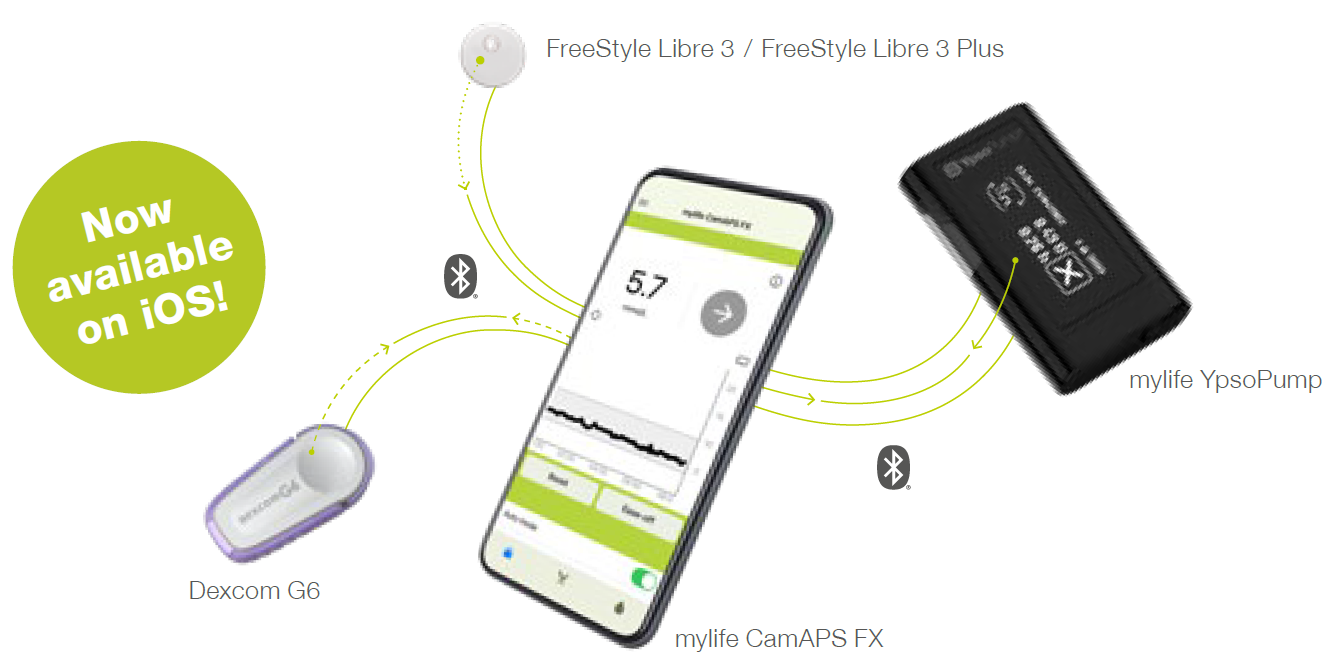
- CGM options: depend on which pump you are on. On the YpsoPump (mylife ecosystem): Dexcom G6, Dexcom G7 (rolling out with CamAPS FX from summer 2026), and the FreeStyle Libre 3 Plus (the AID-paired Libre variant; the standard Libre 3 does not currently pair). On the Dana-i: Dexcom G6 and Dexcom G7 only, no Libre option. Regional availability varies
GNL thinks of CamAPS FX as the Batman of AID systems.

The CamAPS FX algorithm is intelligent and sophisticated, with plenty of tricks up its sleeve. The personal target level has depth and flexibility, and the Add Meal options, with Ease-off and Boost, give the user the tools to stay in range.
System profile
What it looks like
Both are tubed pumps; the reservoir sits inside the pump body and tubing runs to a cannula site. The algorithm itself runs in the CamAPS FX app on the phone, not on the pump.
Two pumps, one app: YpsoPump and Dana-i
CamAPS FX is unusual among current AID systems in offering a genuine choice of pump hardware. The same Cambridge algorithm runs on either the YpsoPump or the Dana-i, both tubed pumps, but the phone platform is not the same on both: the YpsoPump runs the CamAPS FX app on Android or iPhone, while the Dana-i is Android only, worth settling before a phone purchase. The YpsoPump-plus-CamAPS bundle is marketed by Ypsomed as mylife CamAPS, which is why you will see the same system described under both names. Whichever pump you are on, everything in this guide about how CamAPS FX behaves applies equally; the difference is in the hardware and phone platform, not the algorithm.
CGM interoperability
CGM pairing depends on which pump you are on. On the YpsoPump (mylife ecosystem): the established Dexcom G6, the newer Dexcom G7 (rolling out with CamAPS FX from summer 2026), and the FreeStyle Libre 3 Plus (the AID-paired Libre variant; the standard Libre 3 does not currently pair). On the Dana-i: Dexcom G6 and Dexcom G7 only, no Libre option. Regional availability varies, so verify the current market pairing before a market-specific claim.
Age bands and regulatory status
| Indication | Age | Notes |
|---|---|---|
| CE indication | 1 year and older | The widest paediatric indication of any AID system |
| FDA iAGC clearance | 2 years and older | Cleared 23 May 2024 (K232603); includes pregnancy |
First cleared for pregnancy. CamAPS FX was the first closed-loop system to be cleared for use in pregnancy, and the first iAGC to carry a pregnancy indication (Klonoff 2025). It is not the only one now; Tandem Control-IQ and MiniMed 780G are also licensed in pregnancy, but CamAPS FX led here. In the pivotal AiDAPT trial, 124 pregnant women with type 1 diabetes on CamAPS FX spent 68.2% of the day in the tighter pregnancy target range (3.5 to 7.8 mmol/L), against 55.6% on standard insulin therapy with CGM, an adjusted difference of around 10.5 percentage points, roughly two and a half extra hours in range each day, with no meaningful increase in time low (Lee et al. 2023, New England Journal of Medicine, n=124). Any settings change in pregnancy is a conversation with the diabetes-in-pregnancy team.
CamAPS FX has the widest range of indications, from 1-year-olds to pregnancy and older adults. The wealth of research behind this system really stands out.
How the algorithm works
CamAPS FX runs the Cambridge model predictive control (MPC) algorithm, and it is the one system covered here that adapts to you over days and weeks. Where Control-IQ applies a fixed set of rules and 780G tunes around a target you set, CamAPS FX builds a rolling forecast of where your glucose is heading, compares it against your chosen target, and adjusts insulin delivery to steer towards that forecast. Crucially, it also adapts to you in the background over days and weeks, adjusting around your individual day-to-day insulin needs and circadian variation, so the same settings behave differently, and usually better, a month in than on day one (Tauschmann 2018, Lancet; Boughton 2026, Metabologia, n=35,714, median TIR 69.6%). The algorithm itself lives on the CamAPS FX app on the wearer’s Android phone or iPhone, not on the pump: the phone does the forecasting and the pump delivers.
The personal glucose target is the primary lever. The target is the number you and your team set to steer control tighter or looser, and it is what CamAPS FX gives you to adjust across the day, in separate periods, from 4.4 to 11.0 mmol/L (80 to 200 mg/dL) in 0.1 mmol/L steps, default 5.8 mmol/L. This is the setting you reach for session to session: it is the lever you turn, and lower personal targets are associated with more time in range (Ware 2025).
The insulin-to-carbohydrate ratio is a secondary lever, not a direct input to the algorithm. A weaker ICR leaves more of the work to algorithm-driven insulin; a stronger one pulls delivery back towards the bolus insulin you command. The important difference from the other systems is that CamAPS FX does not give you an adjustable insulin-action-time setting the way 780G does; the loop runs its own insulin model, which you cannot shorten or lengthen, and that model is in fact the closest to real physiology of the current systems. The practical consequence is that an ICR set too strong, too much insulin per gram of carbohydrate, is not something you can offset elsewhere: the extra insulin you bolus sits in the system as active insulin the algorithm has to account for and work around, and it cannot simply discount insulin you have already delivered. So be cautious with tight insulin-to-carb ratios; the setting to focus on is the target, not the ICR.
Boost and Ease-off are event-level overrides that sit on top of the chosen target, and both have real-world safety data behind them (Royston and Hovorka 2024, DTT, n=7,464). Boost tells the algorithm to assume roughly 35% higher insulin needs, for illness, growth surges, persistent highs, or pregnancy; during Boost, time below 3.9 mmol/L was 0.0%, with no severe hypoglycaemia or DKA attributed to it, because the algorithm stays glucose-responsive and eases off as glucose falls. Ease-off reduces delivery, for exercise, post-exercise hypo risk, or increased insulin sensitivity; counterintuitively, time above range fell during Ease-off (15% versus 25% outside it), reflecting the exercise-glucose interaction rather than any loss of control. The clinical message: Boost does not cause hypoglycaemia, and Ease-off does not cause hyperglycaemia. Both are most used by caregivers of young children.
This is an algorithm you will not be able to work out or game. It’s better to use the tools provided, such as Ease-off, Boost and Add Meal, to allow the flexibility needed for non-regular situations.
Optimising CamAPS FX: the five-level ladder
The personal glucose target is the primary lever, and the GNL AID Optimiser sets it out as a five-level ladder of algorithm strength. As you move up the ladder, the target comes down and more of your total daily insulin is delivered as algorithm-driven insulin rather than as your own meal boluses. The insulin-to-carbohydrate ratio is the secondary lever: it is set to match the split at each level, so it should be kept sensible rather than tuned hard on its own. There is no user-adjustable insulin-action-time on CamAPS FX, so the target and the split are what the ladder moves.
| Level | Algorithm strength | Target (mmol/L) | Algorithm-driven / bolus insulin | CF rule (mmol/L) |
|---|---|---|---|---|
| 5 | Very high | 4.4 | 65% / 35% | 80 / TDD |
| 4 | High | 5.0 | 60% / 40% | 85 / TDD |
| 3 | Medium (usual start) | 5.5 | 55% / 45% | 90 / TDD |
| 2 | Low | 6.0 | 50% / 50% | 100 / TDD |
| 1 | Very low | 7.0 | 45% / 55% | 110 / TDD |
The correction-factor rule is divided by your total daily dose (TDD) to give the correction factor for that level; the insulin-to-carb ratio is then set to match the algorithm-driven and bolus split, not chosen separately. Most people start around Level 3 and move up in strength as tolerated. All the figures shown sit within CamDiab’s adjustable range.
This ladder is a GNL educational synthesis, Grade D, reviewed with input from the manufacturers’ medical leads but not endorsed; full detail in the Notes below. Any change to your target, correction factor, or insulin-to-carb ratio is a conversation with your diabetes care team.
Target level, correction factor, and the algorithm-driven versus bolus insulin split are the same levers the GNL AID Algorithm Optimiser Explorer works with for this system across these five levels (educational synthesis, not a device setting).
The stop condition. If time below 3.9 mmol/L rises above 4%, hold at the current level or step back down one.
Make use of having different personal glucose targets at different times of the day to manage changing insulin sensitivity. Be careful not to set the carb ratios too strong and constrain the algorithm.
Exercise: getting the most out of Ease-off mode
Ease-off is the exercise mode. It reduces insulin delivery for exercise, post-exercise hypo risk, and periods of higher insulin sensitivity. In real-world data, time above range actually fell during Ease-off (15% versus 25% outside it), reflecting the exercise-glucose interaction rather than any loss of control, and there was no increase in time low (Royston and Hovorka 2024, n=7,464). As with any AID system, activating it ahead of the session, rather than as you start, gives the algorithm time to reduce the insulin already on board.
Then take small carbohydrate top-ups every 20 minutes as needed, rather than one large amount upfront: a big carbohydrate load can spike glucose and prompt a stronger response, raising hypo risk later in the session.
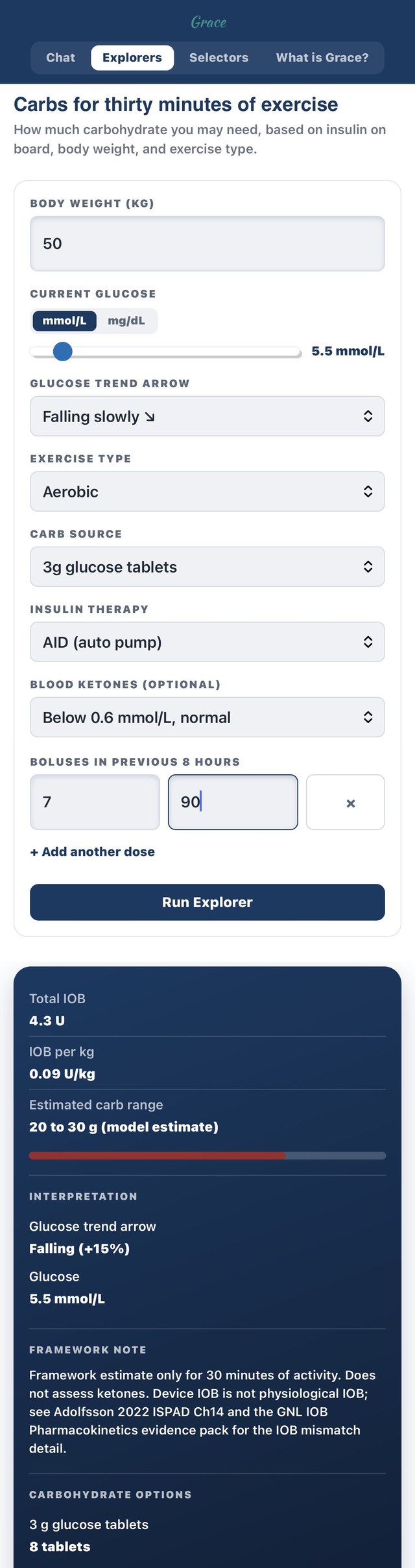
This is a live capture of GNL’s free Carbs for Thirty Minutes of Exercise Explorer, one of the tools on the Grace page. To find it: open theglucoseneverlies.com/gnl-grace, accept the one-off consent step, choose the Explorers tab, then Carbs for Thirty Minutes of Exercise. The snippet below shows the input side (top: 50 kg, 5.5 mmol/L falling slowly, aerobic exercise, AID/auto pump insulin therapy, a 7-unit bolus taken 90 minutes earlier) and the output it produced (bottom: insulin-on-board and the estimated carbohydrate range) for a 50 kg person. Enter your own weight and recent doses to get your own estimate.
For planned, longer sessions, the T25/T25 framework below is written for AID systems specifically; the manual reductions are smaller than the injections or pump-only version because the algorithm is already doing some of the work.
The AID and Exercise Consensus Guideline (EASD/ISPAD 2025, Moser, Zaharieva, Pemberton et al.) is worth reading alongside this.
Use Ease-off, and maybe even an increased personal glucose target, to lower the risk of hypos.
Meals: announcing what a bolus cannot
Boost and Ease-off change how hard the algorithm works overall. The Add Meal menu does something different: it lets you announce a specific event so the loop treats it correctly. There are three options, and each solves a problem a single upfront bolus handles badly.
- Meal or snack. Announces that extra carbohydrate is being eaten. CamAPS FX covers it, but only as glucose actually rises rather than all at once upfront. This is the one to reach for when you have undercovered a meal or your appetite was unpredictable and you want to top up.
- Hypoglycaemia treatment. When you record hypo carbs here rather than as a normal meal, two things happen: the treatment shows up on your Glooko or Diasend download so you and your team can spot patterns, and the algorithm understands those carbohydrates are there to correct a low, not a meal to chase with more insulin. That is what stops the loop stacking insulin on top of your hypo treatment and tipping you back down or into an overshoot.
- Slowly absorbed meal. This is CamAPS FX’s built-in answer to the high-fat, high-protein or very low-GI meal that a normal bolus corrects too early and then loses track of. The technique CamDiab describes is to split the bolus: give the first part the usual way, then enter the remaining carbs in Add Meal and choose “slowly absorbed meal”. CamAPS FX then delivers extra insulin, if it is needed, every 30 minutes for the next 3 to 4 hours as glucose rises, matching the delivery to the slow arrival of the meal. You will see six green triangles on your Diasend download when it has been used.
GNL tip. The slowly absorbed meal option is the feature most people on CamAPS FX underuse. For a steak dinner or a takeaway curry, a single bolus almost always undershoots the late rise; splitting the dose and flagging the second part as slowly absorbed lets the algorithm keep working across the whole three to four hour tail instead of correcting once and stopping.
Try the slowly absorbed meal option for those long-digesting meals, so that the algorithm only gives the extra insulin when it’s required.
Hypo management
The algorithm prevents many overnight hypos by easing or suspending insulin as glucose falls or is forecast to fall, but lows still happen, especially with unplanned exercise or a bolus that turns out too strong for the situation. Treatment amounts often need to be smaller than before AID, because CamAPS FX has usually already reduced delivery earlier than you would expect. Recording the treatment in the Add Meal menu as a hypoglycaemia treatment, rather than as a normal meal, tells the algorithm those carbohydrates are corrective, so the loop does not stack more insulin on top of them.
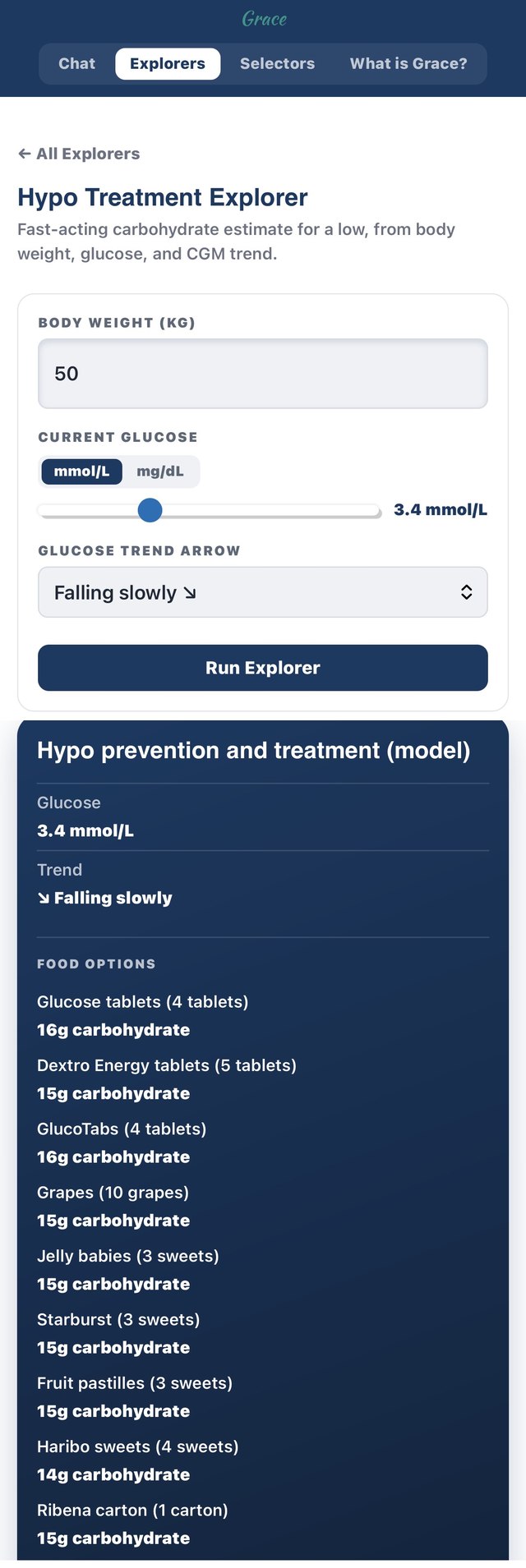
This is a live capture of GNL’s free Hypo Treatment Explorer, another of the tools on the Grace page. To find it: open theglucoseneverlies.com/gnl-grace, accept the one-off consent step, choose the Explorers tab, then Hypo Treatment Explorer. The snippet below shows the input side (top: 50 kg, 3.4 mmol/L, falling slowly) and the output it produced (bottom: a fast-acting carbohydrate estimate with everyday food options). Enter your own weight, glucose, and trend for your own estimate.
The technical detail: why treatment amounts shrink on AID
Pre-AID hypo treatment amounts are usually sized assuming insulin delivery continues unchanged until you intervene. CamAPS FX has typically already been easing or suspending delivery for a while before you notice the low, so there is less insulin working against the treatment than a pre-AID rule of thumb assumes. The same weight-based amount that was right before AID commonly overshoots afterwards.
Make sure to use the Add Meal hypoglycaemia treatment option, to prevent rebound extra insulin after the hypo treatment.
Hyper management
CamAPS FX brings a lot of highs down on its own, and Boost is the mode to reach for when insulin needs are genuinely higher, for illness, a growth surge, or a run of persistent highs. Boost assumes around 35% more insulin and stays glucose-responsive, so in real-world data it did not drive glucose low (time below 3.9 mmol/L was 0.0% during Boost). But a high with rising ketones is a different situation, one the algorithm does not manage on its own: it does not check for ketones and does not know if an infusion set has failed. A rising glucose that the loop is not bringing down, especially alongside nausea or abdominal pain, needs the same ketone check and sick-day pathway as it would on any other therapy.
This is a live capture of GNL’s free Hyper Treatment Explorer, another of the tools on the Grace page. To find it: open theglucoseneverlies.com/gnl-grace, accept the one-off consent step, choose the Explorers tab, then Hyper Treatment Explorer. The snippet below shows the input side and the output it produced. Enter your own weight, TDD, glucose, and ketone reading, and select your own system under Therapy or AID, for your own estimate.
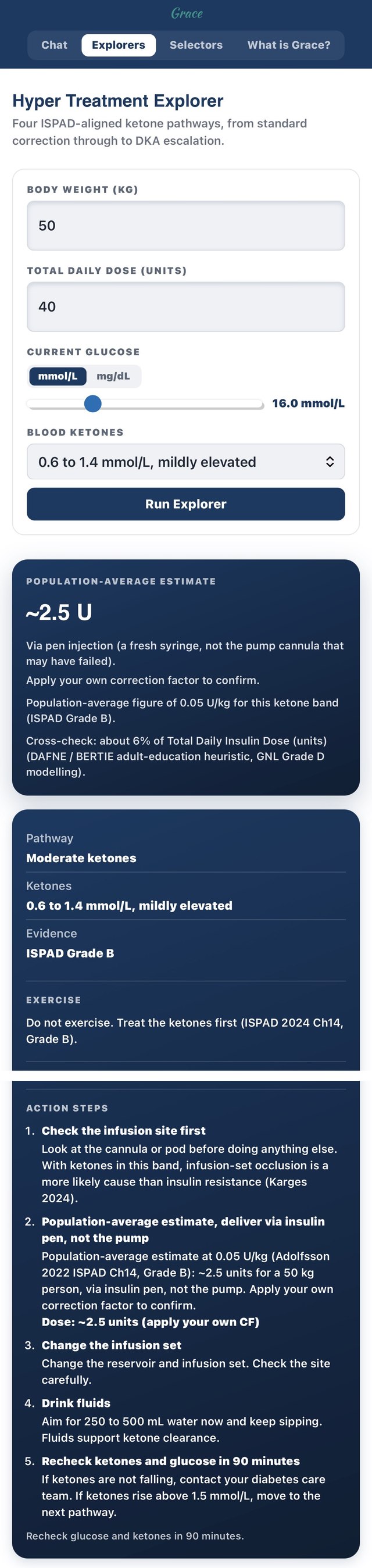
The same approach as for the other AID systems applies here.
Under-5s
CamAPS FX carries the widest paediatric indication of any AID system, licensed from age 1, and the low adjustable target with Boost and Ease-off is what makes it workable for the unpredictable eating and pronounced overnight glucose swings of infants and pre-schoolers. Because the target floor goes as low as 4.4 mmol/L and moves in 0.1 mmol/L steps across separate periods of the day, families can steer tighter overnight and looser through the day with their diabetes team.
Children under six show a distinct diurnal insulin-need pattern: a clear evening rise in insulin need followed by an overnight fall (Biester et al. 2023, DPV registry, n=25,718). On CamAPS FX, the lever families use with their team is the personal target across those windows, tighter overnight and easing through the evening rise, the same dusk-then-dawn pattern that shapes preschool settings on every AID system, not just this one. This is a clinic conversation, not a parental adjustment. GNL covers that overnight “dusk till dawn” pattern in the under-5s in detail, with real before-and-after CGM traces, in the infants and pre-schoolers guide.
The evidence for starting young. In CLOuD (Ware et al. 2024, Diabetes Care), children starting CamAPS FX close to diagnosis and followed to 48 months gained around 12 percentage points of time in range and lowered HbA1c by around 0.9%, with no effect on residual C-peptide. Any settings change for a very young child is a care-team decision, not a parental adjustment.
Try a relaxed personal glucose target from 11am to 3pm, with a much lower target from 6pm to 10pm and a higher target overnight, to manage the dawn and dusk phenomenon.
Listen: Mastering CamAPS FX
For the wider picture across all the systems: Episode 6: Ten Tips to Optimise Time in Range, paired with the Top 10 Tips to Optimise Time in Range: AID Systems page.
Try the Batman podcast to get skilled up on CamAPS FX.
Notes
Regulatory detail, evidence depth, and framing caveats behind this page
- GNL Insights. The GNL Insights boxes through this guide are the team’s own perspective and clinic experience: opinion and pattern-recognition, not a stated clinical fact or a personalised recommendation, distinct from the sourced claims and citations elsewhere on this page.
- Not a CamDiab-endorsed configuration (Optimising CamAPS FX). The five-level ladder is a GNL educational synthesis (Grade D on a Grade A/B evidence base). The ladder, and the settings adjusted at each level, were reviewed and refined with input from the CamAPS, MiniMed, Tandem and Insulet global medical leads (the CamAPS input came from the Hovorka group) but not endorsed; the levels are not validated against any manufacturer’s simulator. All settings shown sit within CamDiab’s adjustable range. Any settings change is a conversation with your diabetes care team.
- Choice of pump (System profile). CamAPS FX runs on the YpsoPump or the Dana-i, both tubed. It never works with only one pump; the YpsoPump-plus-CamAPS bundle is marketed as “mylife CamAPS”, which is a bundle brand, not a claim that one configuration is dominant.
- Pregnancy (System profile). CamAPS FX was the first closed-loop system cleared for use in pregnancy (the first iAGC with a pregnancy indication, Klonoff 2025); it is not the only one now, as Tandem Control-IQ and MiniMed 780G are also licensed in pregnancy. AiDAPT (Lee et al. 2023, NEJM, n=124) is the pivotal evidence; the pregnancy target range (3.5 to 7.8 mmol/L) is tighter than the standard range.
- Add Meal announcements (Meals, Hypo). The Meal or snack, Hypoglycaemia treatment, and Slowly absorbed meal options are sourced from CamDiab’s own “Managing Meals” factsheet (accessed 19 July 2026). Population-average behaviour; individual responses vary.
CamAPS FX Knowledge Check
That was the real-world guidance for getting the best from CamAPS FX. A short assessment on it follows, and 9 out of 10 earns your certificate.
References
Key papers and sources behind this page. Tap to expand.
Real-world outcomes and the algorithm
- Tauschmann M et al. (2018). Closed-loop insulin delivery in suboptimally controlled type 1 diabetes. Lancet. 392:1321-1329. Pivotal CamAPS RCT.
- Boughton CK, Bergford S, Hovorka R (2026). CamAPS FX real-world registry. Metabologia. 2:1. n=35,714. Median TIR 69.6%. DOI: 10.1007/s44357-025-00002-2.
- Alwan H et al. (2023). Real-world mylife CamAPS FX outcomes. Journal of Diabetes Science and Technology. n=1,805, 15 countries. Overall TIR 72.6%.
Boost and Ease-off safety
- Royston C, Hovorka R (2024). Boost and Ease-off real-world analysis. Diabetes Technology and Therapeutics. August 2024. n=7,464. TBR 0.0% during Boost; TAR 15% vs 25% during Ease-off.
Pregnancy (AiDAPT)
- Lee TTM et al. (2023). Automated insulin delivery in women with pregnancy complicated by type 1 diabetes (AiDAPT). N Engl J Med. 389(17):1566-1578. n=124; pregnancy-range TIR 68.2% vs 55.6%. DOI: 10.1056/NEJMoa2303911.
Paediatric and meal evidence
- Ware J et al. (2024). Closed-loop from diagnosis in young children (CLOuD), 48 months. Diabetes Care. TIR +12pp, HbA1c -0.9%. DOI: 10.2337/dc24-0360.
- Biester T et al. (2023). DPV registry, under-6 diurnal insulin-need pattern. Diabetes Technology and Therapeutics. n=25,718.
- CamDiab “Managing Meals” factsheet (CamDiab Ltd, www.camdiab.com), accessed 19 July 2026. Add Meal announcement types.
CamAPS FX