The GNL Podcast
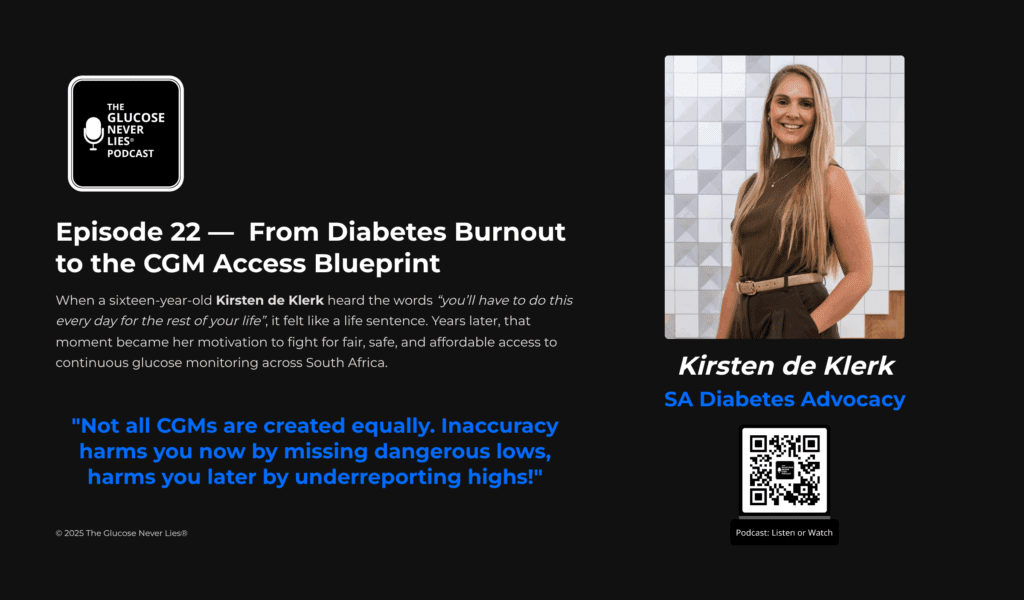
Episode 22, from diabetes burnout to the CGM Access Blueprint
A sixteen-year-old sits in a clinic room and asks how long she has to do this for. The answer, every day for the rest of your life, lands like a sentence. Years later, on a Cape Town beach, she writes a letter to her diabetes and something shifts. That letter became the start of a national campaign.
Ask Grace
Want to know why 70% time in range on one CGM might be 60% on another, and what makes a sensor accurate enough to dose insulin from?
Listen or watch
Sign the CGM Access Petition, in less than one minute, you can help change global access to CGM.
Why this episode exists
If you live with type 1 diabetes, you already know the work it takes to keep going: the testing, the dosing, the quiet calculations that never fully stop. You also know that the technology which makes that work lighter is not within everyone’s reach equally, and that knowing a device exists is not the same as being able to get it. That gap between what should be possible and what is actually available is where this episode lives.
Kirsten de Klerk’s story shows both sides of it. A two-week continuous glucose monitoring (CGM) trial gave her back a sense of control, and at the same time exposed how few people in South Africa could reach the same technology. Eighty-five per cent of the population rely on public healthcare, where most people living with type 1 diabetes receive just three blood glucose test strips per day. The evidence anchor of the episode is not a single statistic; it is the distance between those two realities, and what one advocate did to close it.
In this episode
When a sixteen-year-old Kirsten de Klerk heard the words “you’ll have to do this every day for the rest of your life”, it felt like a life sentence. Years later, that moment became her motivation to fight for fair, safe, and affordable access to continuous glucose monitoring (CGM) across South Africa.
This episode follows her journey from diabetes burnout to national advocacy, combining community, clinical evidence, and courageous persistence to build what is now known as the CGM Access Blueprint.
John Pemberton is joined by Kirsten, a Cape Town-based type 1 diabetes advocate whose story captures both the personal and political dimensions of living with diabetes in an unequal healthcare system. Diagnosed at sixteen, Kirsten’s journey begins with the innocent question every teenager might ask: “How long do I have to do this for?” Her doctor’s reply, “Every day for the rest of your life”, marked the start of a lifelong negotiation between reality and resilience.
University life brought late nights, skipped meals and denial. Diabetes ended up in the boot of the car, always there, never a priority. Eventually she stopped testing altogether. This was the beginning of burnout, not laziness, but emotional overload, guilt, and silence. Recovery came unexpectedly. Sitting on a Cape Town beach, Kirsten wrote a #LetterToMyDiabetes and experienced what she calls a moment of truth. That letter became the start of her advocacy work.
Episode chapters
- 00:10 to 01:00 The Glucose Never Lies® mission, translating science into real-world action
- 02:47 to 04:00 Diagnosis at 16 and the moment reality hits
- 08:25 to 09:19 Burnout and self-blame, keeping diabetes in the boot
- 09:19 to 12:00 #LetterToMyDiabetes, the spark that rebuilt connection
- 14:19 to 17:49 Two-week CGM trial that changed everything
- 17:49 to 22:00 From privilege to purpose, recognising access inequality
- 22:00 to 31:29 Building South Africa’s advocacy network and petition (14,000 signatures)
- 31:29 to 37:23 Negotiating with funders, turning frustration into progress
- 37:23 to 49:24 CGM accuracy and global standardisation, why 70% doesn’t always mean 70%
- 52:46 to 54:00 Redirection, not rejection, hope as a strategy
Watch or listen
Key themes
From burnout to blueprint
Burnout in diabetes is a predictable outcome of long-term self-management without emotional support, not a personal failing. Kirsten describes the arc in three movements: from control to collapse, where self-management without emotional support eventually breaks; from avoidance to acceptance, where writing and community become tools for healing and accountability; and from isolation to advocacy, where private struggle turns into public purpose. The discovery of CGM marked a pivotal chapter. A two-week trial changed everything, in her words, “One device. Two weeks. No going back.”
Building the CGM Access Blueprint
The same trial that gave Kirsten back a sense of control also exposed injustice: while the technology helped her, she saw how few people in South Africa could access it. Alongside Bridget McNulty, she co-founded SA Diabetes Advocacy, creating an online petition, a mentorship programme, and a free four-week Advocacy Course to teach others how to campaign effectively in their communities. Over 14,000 signatures were gathered for the national CGM access petition, support letters were secured from endocrinology units across South Africa, and direct negotiations opened with major medical aid funders. An early success followed: funding secured for children under 18 to receive CGM sensors on a tiered plan.
The accuracy debate
Kirsten’s advocacy intersected with CGM accuracy and comparator bias. As cheaper sensors entered the market, she noticed that many devices lacked proper testing or transparency. Together, John and Kirsten outline three things every policymaker, clinician, and person living with diabetes should understand. First, not all CGMs are created equally: some systems are clinically validated for insulin dosing, others are not, and price competition must not compromise safety. Second, inaccuracy harms you now, because when CGMs fail to detect highs or lows, people are put at immediate risk. Third, inaccuracy harms you later, because systems that systematically under- or over-report glucose create false reassurance, and 70% time-in-range on one device might be 60% on another. As the episode puts it, “Access without accuracy is false progress.”
Redirection, not rejection
Despite resistance, delays, and limited resources, Kirsten’s next goal is to bring the petition model into public healthcare, with letters of support from all provincial endocrinology units to the South African Department of Health. For Kirsten, South Africa is more than a local challenge, it is a test case for the world.
Access and accuracy pull in different directions. Cheaper sensors widen access, which is the whole point of the campaign; but a sensor that is not validated for insulin dosing can give false reassurance, and a global standard is the only thing that makes 70% on one device mean the same as 70% on another. The episode names this trade-off plainly: access without accuracy is false progress, and global standardisation of CGM testing is essential so that 70% must always mean 70%.
Practical exploration
For people living with type 1 diabetes and their families
Kirsten’s story is a reminder that the emotional load of diabetes is part of the condition, not a weakness on top of it, and that the route out of burnout often starts with connection rather than correction.
- Burnout is not weakness; it is a predictable outcome of chronic self-management without emotional support. Recognising it is the first step, and advocacy starts with acceptance: connection before correction.
- If you are weighing up a CGM, accuracy is worth asking your care team about, not just availability. A device that is clinically validated for insulin dosing is a different proposition to one that is not, because CGM access without accuracy creates a false sense of safety.
- Hope and persistence can be treated as strategic tools rather than moods. In Kirsten’s framing, there is no such thing as rejection, only redirection.
For clinicians, educators, and advocates
The CGM Access Blueprint begins with South Africa, but its lessons apply everywhere.
- Global standardisation of CGM testing matters because 70% must always mean 70%. Where you can, point people and policymakers towards comparison resources that make device differences visible.
- A petition with broad clinical backing (over 14,000 signatures and support letters from endocrinology units) is a model others can copy, not a one-off.
- During the episode, John and Kirsten reference the short film Step to the Line (Soul Pancake), which visualises privilege and opportunity and is a useful way to open a conversation about why equity means meeting people where they start, not where we stand.
Take action
- Sign the CGM Access Petition, it takes less than a minute.
- Share the DSN Forum CGM comparison chart with your diabetes team.
- Read the FIND Diagnostics CGM accuracy factsheet.
About the guest
Kirsten de Klerk is a Cape Town-based type 1 diabetes advocate, diagnosed at sixteen. Alongside Bridget McNulty she co-founded SA Diabetes Advocacy, building an online petition, a mentorship programme, and a free four-week Advocacy Course. Her campaigning gathered over 14,000 signatures for South Africa’s national CGM access petition, secured support letters from endocrinology units across the country, and opened direct negotiations with major medical aid funders, including an early success funding CGM sensors for children under 18 on a tiered plan.
Connect with Kirsten de Klerk
Related reading on GNL
Episode 22 of the GNL Podcast
From burnout to the CGM Access Blueprint
This content is for educational exploration only. It describes average responses and general principles. It is not medical advice and cannot replace individual clinical guidance from your diabetes care team.