
Dynamic Glucose Management
GAME: Stop Highs Without Insulin Stacking
Using fast movers, usually short bursts of movement, to manage glucose rises between meals, instead of relying on repeated correction insulin.
Ask Grace
Curious what insulin stacking is, and why it happens? Ask Grace.
What is GAME?
GAME is the Stop Highs pillar of Dynamic Glucose Management. The mechanism: manage glucose rises between meals using fast movers, usually short bursts of movement, rather than relying on repeated correction insulin.
This matters because correction insulin is slow and long-acting. When highs are chased with insulin alone, glucose often continues to rise before the insulin takes effect. The result is a familiar pattern: stacking, delayed hypoglycaemia, and rebound highs.
GAME works by flipping the default response. When glucose starts climbing between meals, the idea is to act early with something that works now, not in 90 minutes.
For the physiology and evidence behind this approach, the Episode 8 podcast explores this in depth:
Podcast: Episode 8, Activity Snacking to Increase Time in Range
Video overview
The mechanism
GAME is built on the fast versus slow movers model.
Between meals, movement is typically a fast mover for lowering glucose. Correction insulin is a slow mover with a long tail. The exact effect of movement depends on insulin on board, intensity, timing, and individual sensitivity, which is why CGM feedback is so central to this approach.
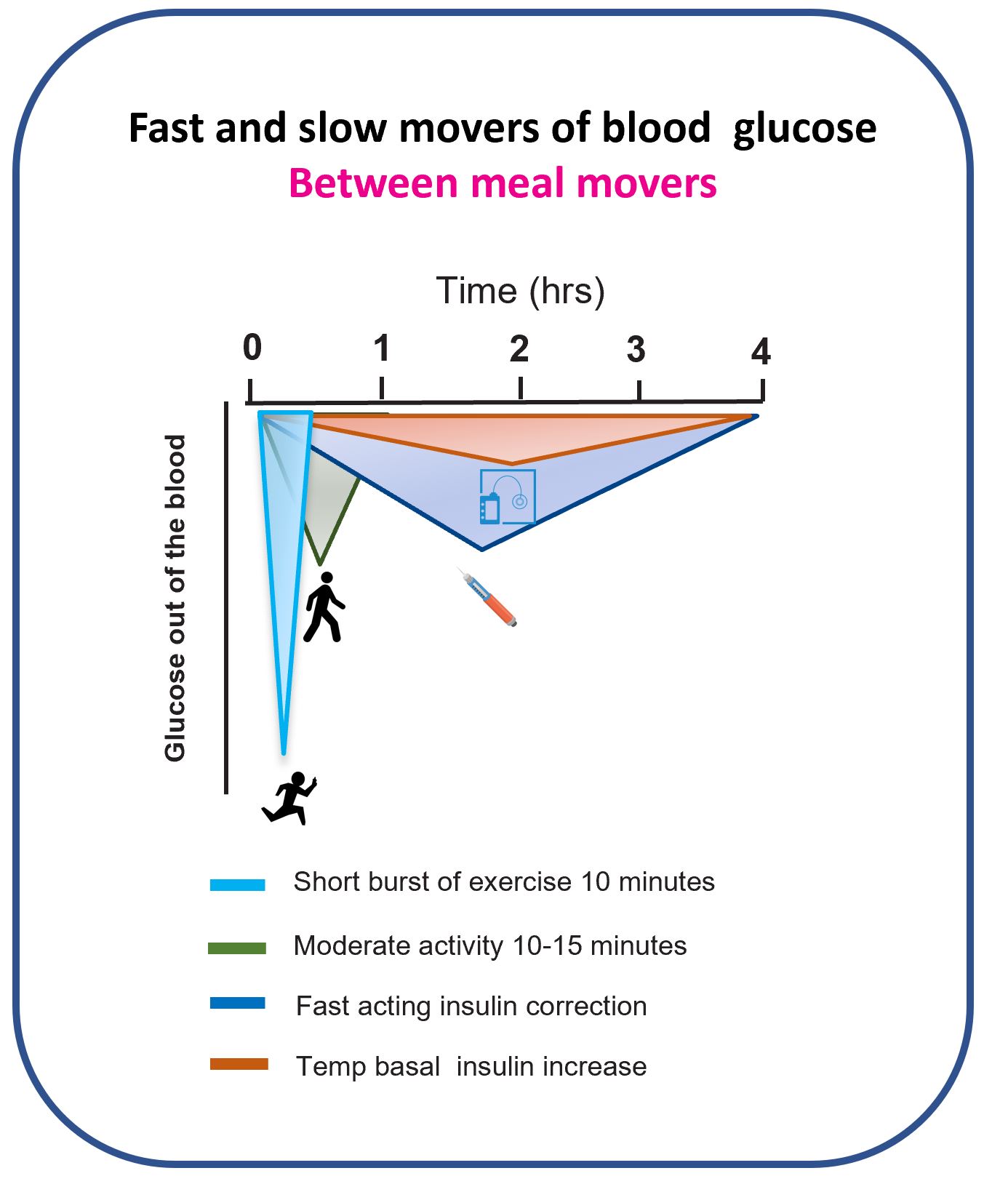
The problem GAME addresses is correction chasing. When glucose rises, the first correction has not visibly worked yet, so more insulin is added. Hours later, insulin stacks, glucose drops too far, and extra carbohydrate is needed to rescue it.
GAME interrupts that loop by acting early with a fast mover, preventing the need for repeated insulin corrections in the first place.
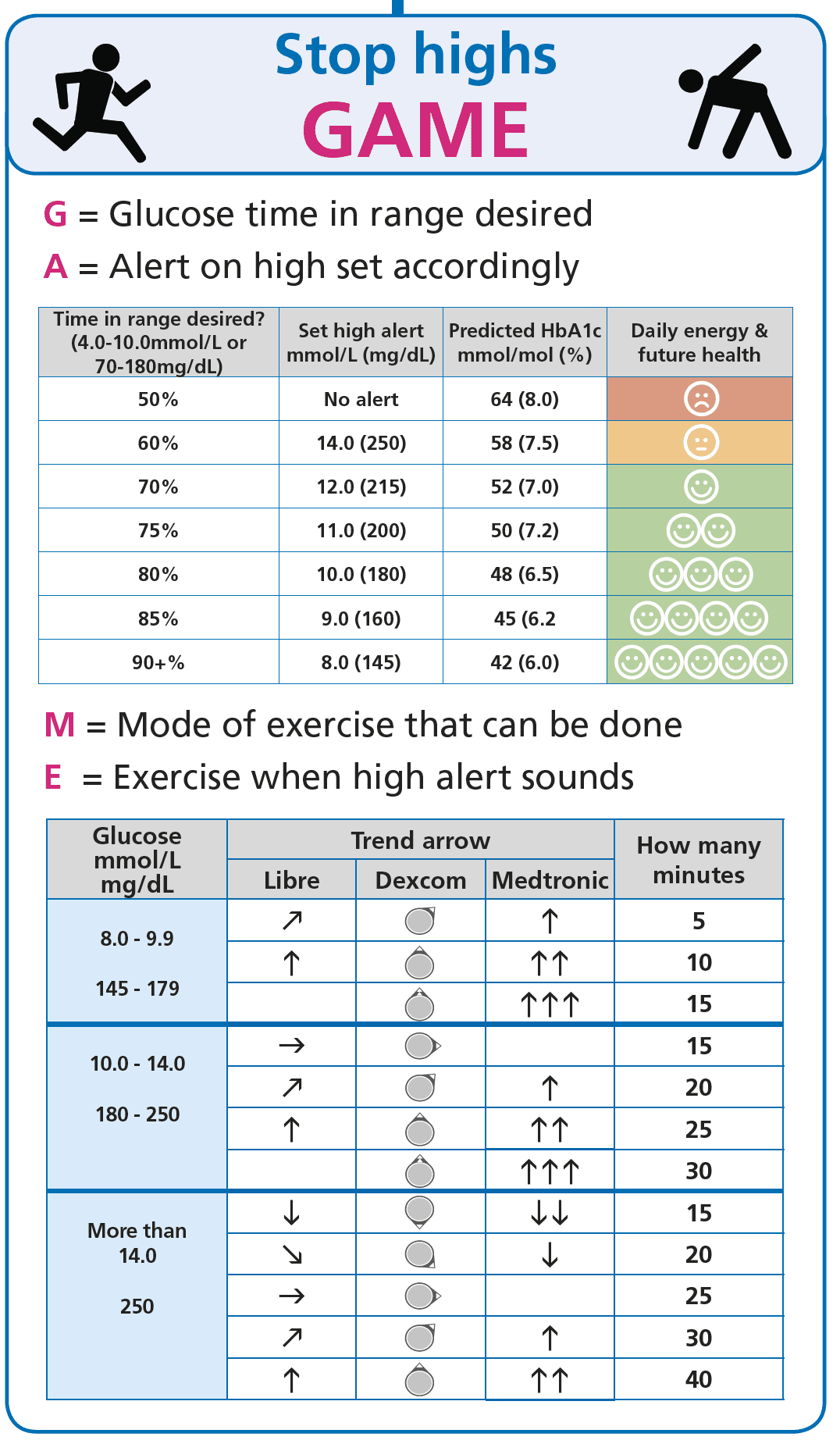
In practice, GAME means setting a high glucose alert that matches your current goals, then responding with a short burst of movement when the alert goes off. Over time, you refine the alert level, the movement type, and the duration using CGM data.
Real-world data suggest that even modest use of GAME can markedly increase time in range while reducing hypoglycaemia. As alert thresholds are lowered and movement dosing improves, time in range can be pushed further, at the cost of more effort.
Practical exploration
GAME is scalable. Many people find it useful to start with a higher high-alert so movement is only needed occasionally. As meal stability improves, often via SET, the number of bursts typically falls.
Movement does not need to be jogging on the spot. Walking, stairs, cycling, skipping, rowing, star jumps, anything that uses a large amount of muscle mass and is practical in your real environment can work. What tends to work best varies by person, insulin on board, and context.
Correction insulin still has a role: overnight, when movement is impractical, or in settings where activity is not possible. GAME is not an all-or-nothing rule.
Early hypoglycaemia after using GAME usually means the movement dose was too large. Using CGM trends to learn what 5 minutes does, what 10 minutes does, and how those effects change with insulin on board is the core of the feedback loop.
The Glucose Never Lies. Let the data guide the adjustment.
Exploring GAME with your CGM data
This content is for educational exploration only. It describes average responses and general principles. It is not medical advice and cannot replace individual clinical guidance from your diabetes care team.
The mechanism of GAME, early movement to interrupt rising glucose between meals, is consistent on average, but the response varies considerably between people and situations. CGM data is the feedback tool that makes refinement possible. This is worth exploring with your care team if you are considering using GAME regularly.