
The Dynamic Glucose Management Guide
Dynamic Glucose Management
An hour into Christmas dinner, the glucose line turns upward and refuses to settle. Five insulin corrections and five hours later, it finally comes back to range. The same meal a year on holds steady without a single correction. The difference was not more insulin. It was speed.
Ask Grace
Want to explore what your CGM trend arrows are telling you in real time? Ask Grace.
What this guide covers
If you have watched a post-meal spike sit stubbornly high for hours, or treated a low and then chased the rebound that followed, you already know the frustration this framework is built to remove. Dynamic Glucose Management is a practical route to high time in range that leans on fast movers between meals, short bursts of activity to bring highs down and measured glucose to lift lows, rather than on slow insulin corrections alone.
In Grace’s evidence base the framework is graded B: it rests on a published single-centre structured-education programme in children and young people, supported by real-world continuous glucose data, and illustrated by one person’s own before-and-after device comparisons. The Foundations tier teaches safety first; this is where that safety becomes skill.
Before you begin
This guide assumes two things are already in place. Continue only if both are true.
- You have completed and genuinely understood the Foundations section.
- You are using a CGM with alarms. Here the CGM is both the teacher and the safety net; the alarms are what make fast movers safe to use.
The framework rests on three pillars, GAME, SET and MATCH.

Video: Dynamic Glucose Management explained
The video below is the recommended starting point for seeing how the three pillars fit together before working through the detail.
The mechanism: fast movers and slow movers
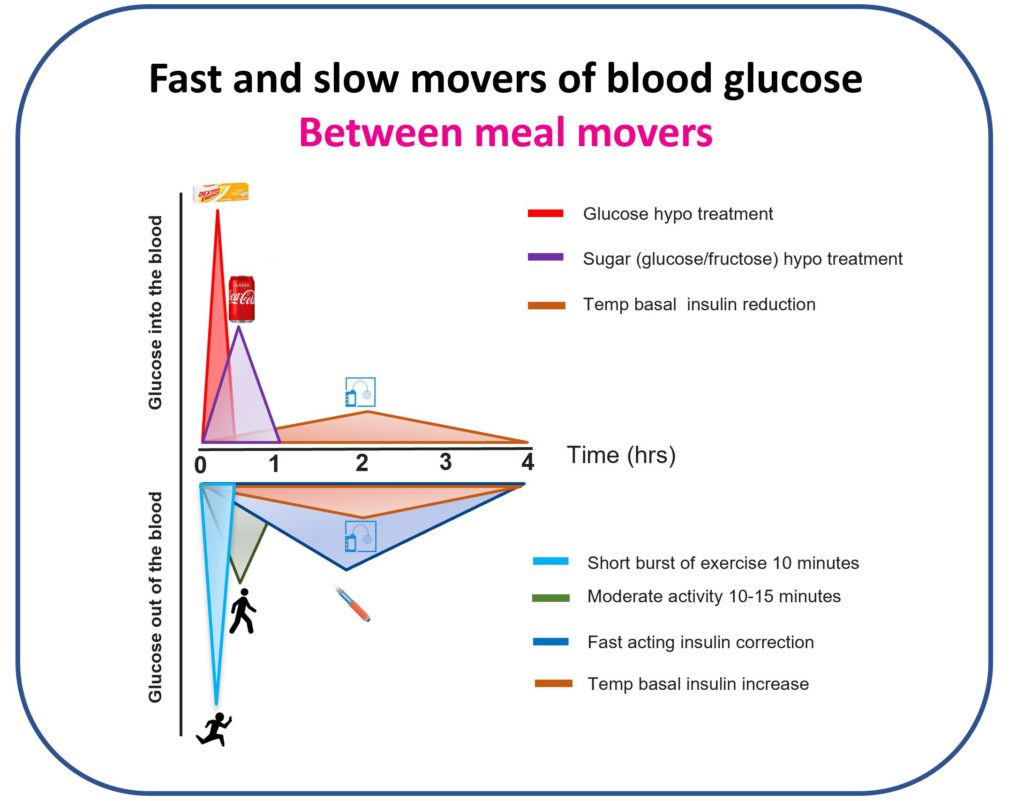
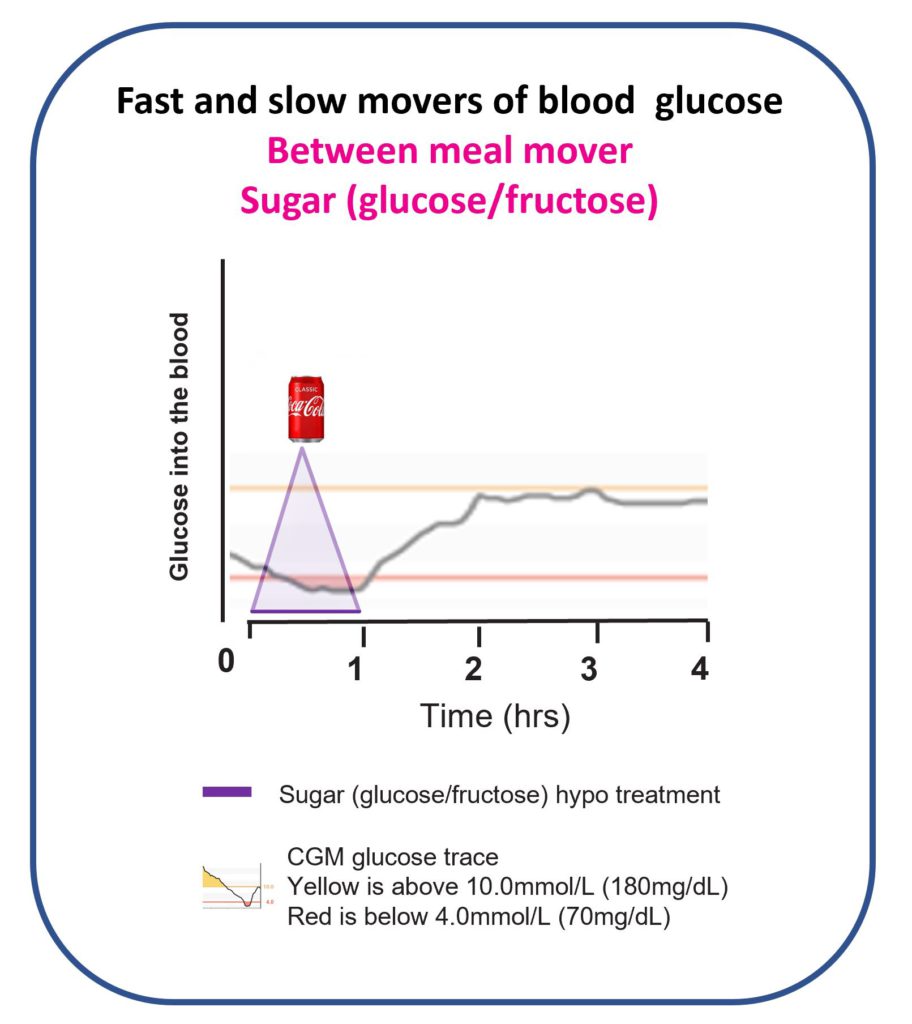
Between meals, the tools available to shift glucose divide cleanly into two speeds. The default approach, correcting highs with insulin and treating lows with sugary drinks, relies almost entirely on the slow ones.
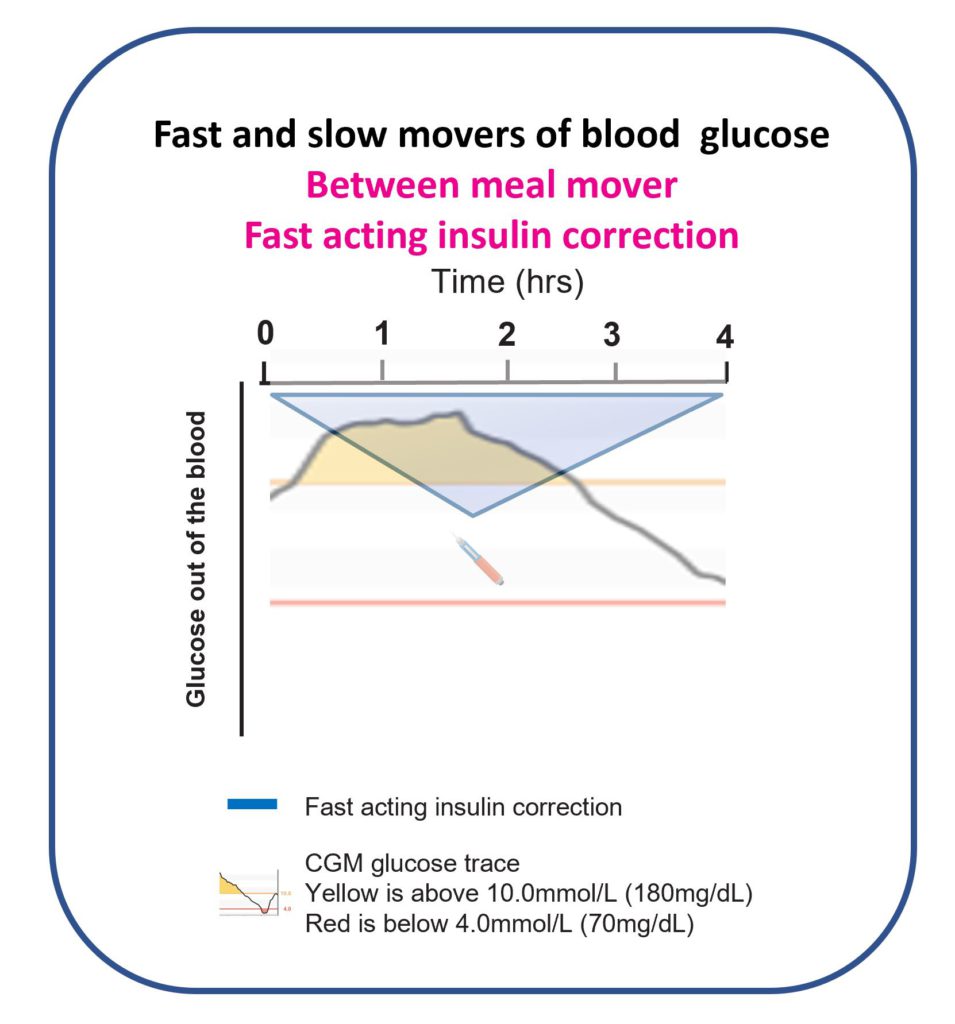
Rapid-acting insulin peaks around 90 minutes after injection and keeps lowering glucose for roughly four hours. When corrections stack on top of each other before the earlier ones have finished, the combined effect eventually overshoots and glucose drops sharply. Sugary drinks are similarly slow to arrive and hard to titrate. The data shows the problem is rarely the amount; it is the lag between acting and seeing a result.
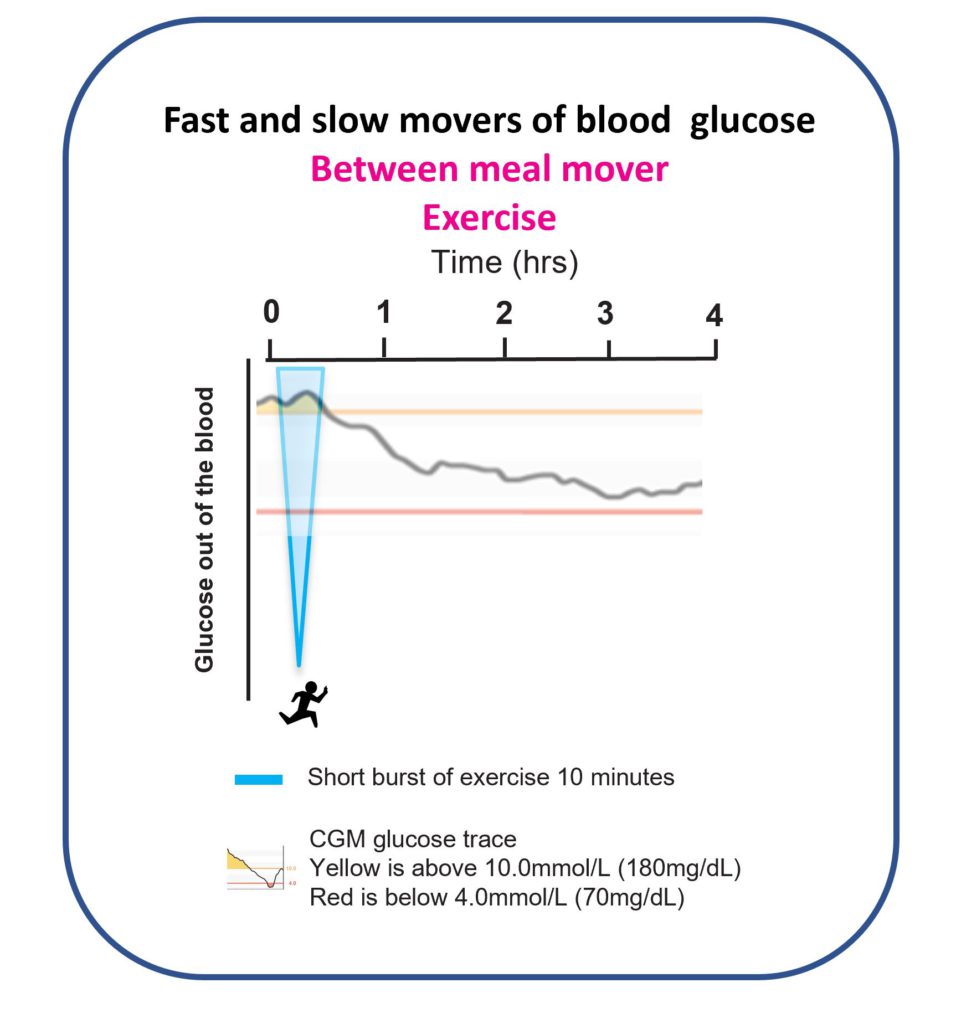
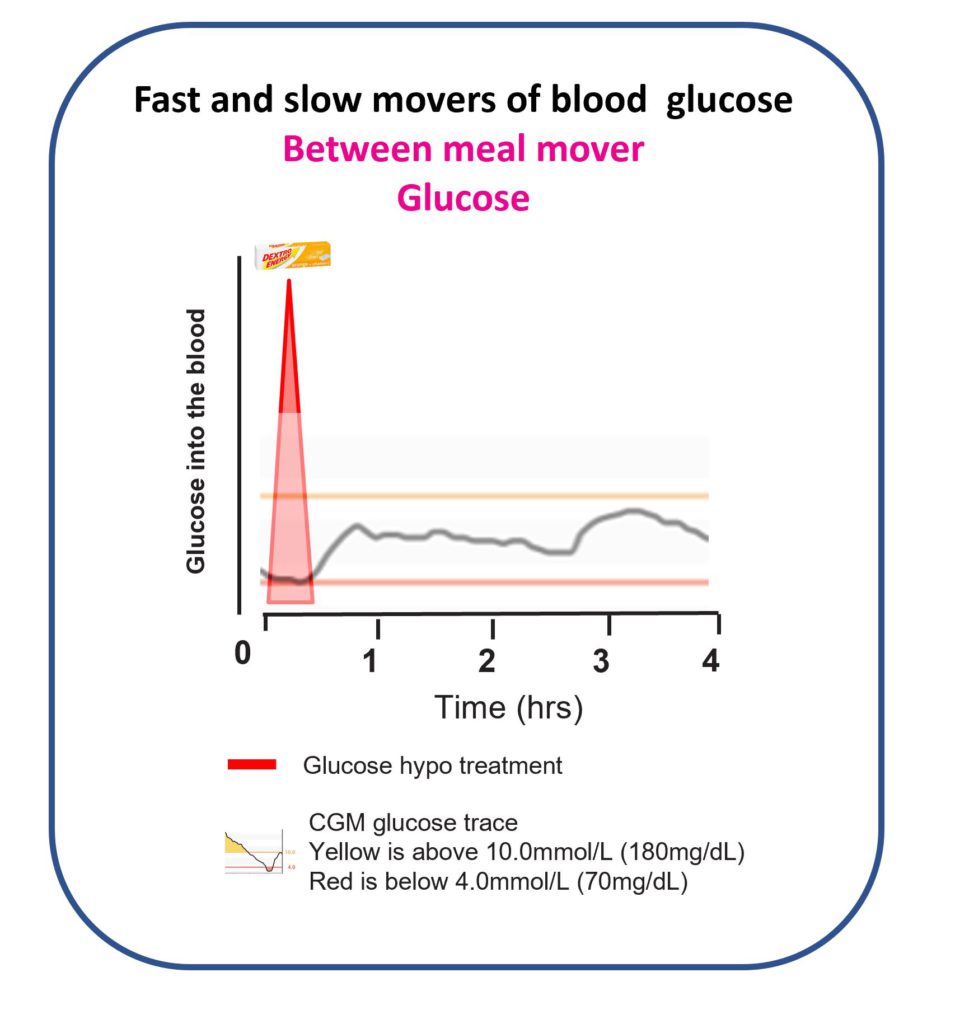
The fast movers change that picture. A short burst of activity tends to bring a between-meal high down within 10 to 30 minutes, far quicker than the three to four hours a correction dose needs. Pure glucose, taken in measured amounts, lifts a low predictably and can be stopped before it turns into a rebound. Same goal, faster and more precise tools.
Where the framework came from: a documented before and after
The framework emerged over more than a decade of lived Type 1 self-experimentation and clinical practice. The clearest single illustration of why it works is a direct comparison of the same festive day, one year apart, captured on CGM.
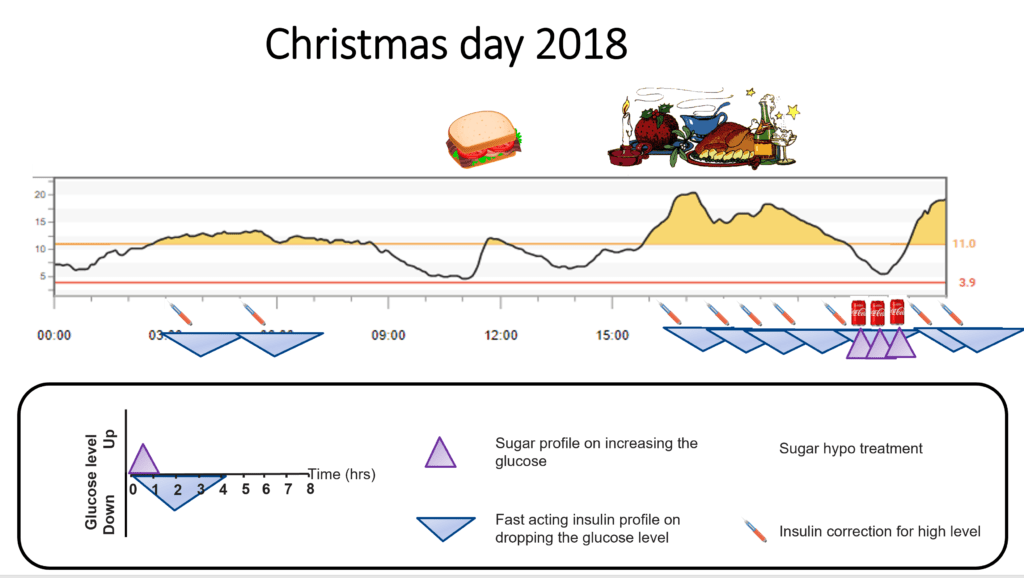
Christmas Day 2018, the slow lane
The plan was conventional: correct highs with insulin, prevent lows with cola, high alert set at 11.0 mmol/L (200 mg/dL). Carbohydrates were weighed and counted, insulin delivered 20 minutes ahead. An hour after Christmas dinner glucose climbed steeply, and it took five separate corrections over five hours to return to range. The meal dose was 10 units for around 200 g of carbohydrate; corrections added another 15 units, a total of 25 units, roughly 150% more than the meal alone. Three portions of cola were then needed to catch the drop that followed. Glucose was, by the end of the day, thoroughly outwitted.
Christmas Day 2019, the fast lane
The same food, the same 10-unit meal dose, the same 11.0 mmol/L (200 mg/dL) alert, but fast movers throughout. When glucose nudged up after lunch, 10 minutes of high knees brought it back almost immediately, exactly as the Activity and movement page describes. Before dinner, glucose drifted low; rather than a full treatment, three dextrose tablets produced a controlled rise back to mid-range without overshoot. As Christmas dinner pushed glucose upward, short bursts of activity across the afternoon held it in range through to bedtime. In range overnight, no insulin stacking, no glucose stacking.
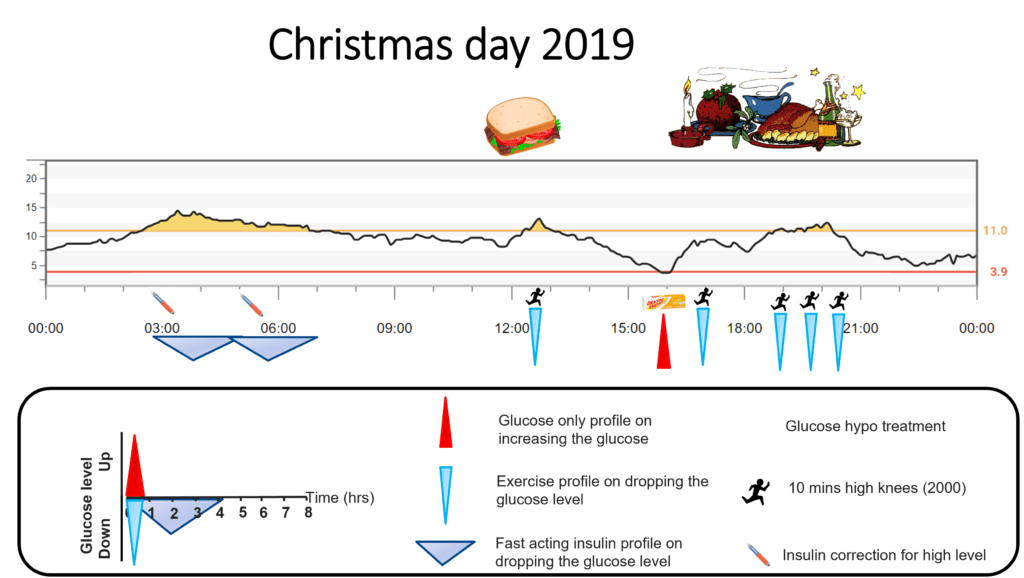
This was a deliberate demonstration, not a daily routine; no one eats a full Christmas dinner every day, and no one needs that volume of activity to manage diabetes. What the two traces show, side by side, is how much the choice of tool speed changes what is possible.
The four movers, one at a time
The two traces above turn on four tools. Insulin corrections and sugary drinks are the slow movers; short activity and pure glucose are the fast movers.
GAME, SET and MATCH: the three pillars
The comparison resolves into three pillars, each with its own page. Work through them in order.
Stop highs, GAME
- G: Glucose time in range desired
- A: Alert on high set according to the desired time in range
- M: Mode of exercise that can be done anywhere
- E: Exercise on high alert, based on glucose value and trend arrow
Stay in target, SET
- S: Start insulin before eating
- E: Eat three balanced meals
- T: Ten minutes of activity after eating
Prevent lows, MATCH
- M: Measure weight to calculate hypo treatment dose
- A: Always use glucose only, not sugar
- T: Try to prevent lows before they happen
- C: Change treatment based on glucose value and arrow
- H: Have patience and wait 20 minutes
How Dynamic Glucose Management compares with AID systems
What follows describes what automated insulin delivery did and did not do in one individual’s diabetes. It is a single individual’s own data (n=1), not a general claim about AID performance across all users.
In that individual’s data, their own use of DIY looping, Control-IQ and the 670G each sat at around 85% time in range with roughly 3% time below target. That is solid control. Dynamic Glucose Management during waking hours pushed the same person’s figures to around 99% time in range with roughly 1% time below target.
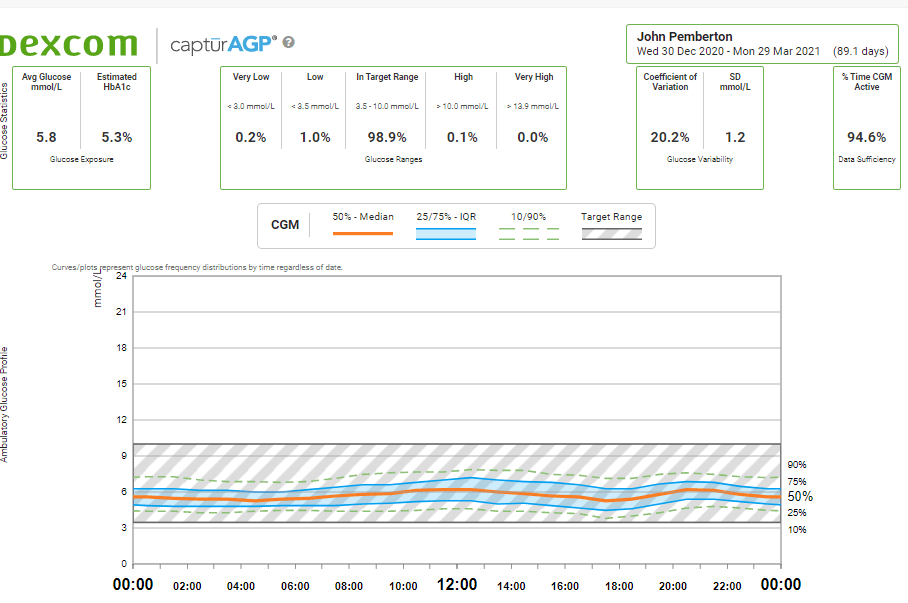
The reason sits in the mechanism. AID systems are excellent overnight, when liver glucose output is the main variable and insulin alone can manage it well. During the day, food, activity, stress and unpredictability enter the picture, and insulin, a slow mover, cannot keep pace with those variables as quickly as fast movers can. In the same personal data, AID typically held around 50% of time in the tight non-diabetic range of 3.3 to 6.7 mmol/L (60 to 120 mg/dL); Dynamic Glucose Management raised that to around 80% during the day.
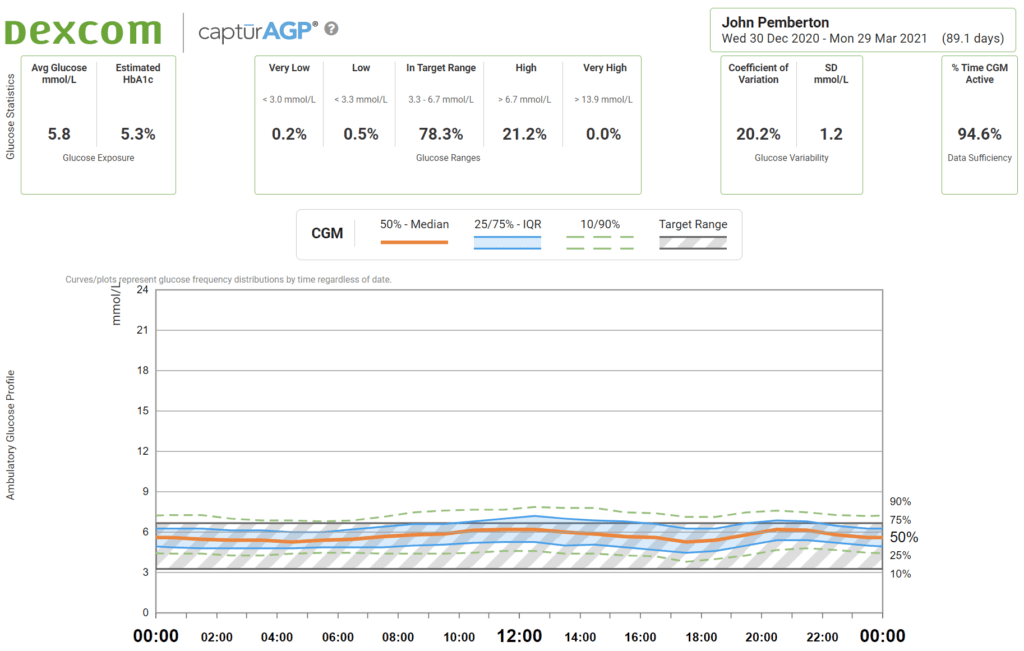
The practical read is that the two approaches complement each other: an AID system overnight for safe sleep, Dynamic Glucose Management during waking hours. The framework asks for time, attention and persistence, which some people will find engaging and others will not. Both responses are reasonable; it is an individual choice based on individual circumstances, and one worth talking through with your care team.
You do not have to choose between tight glucose and eating normally. The only other approach found to match this level of control is severe carbohydrate restriction, explored in the 120-day carbohydrate experiment. Provided fast movers are used between meals, near-perfect control does not require cutting carbohydrates to the bone.
What the evidence shows in children and young people
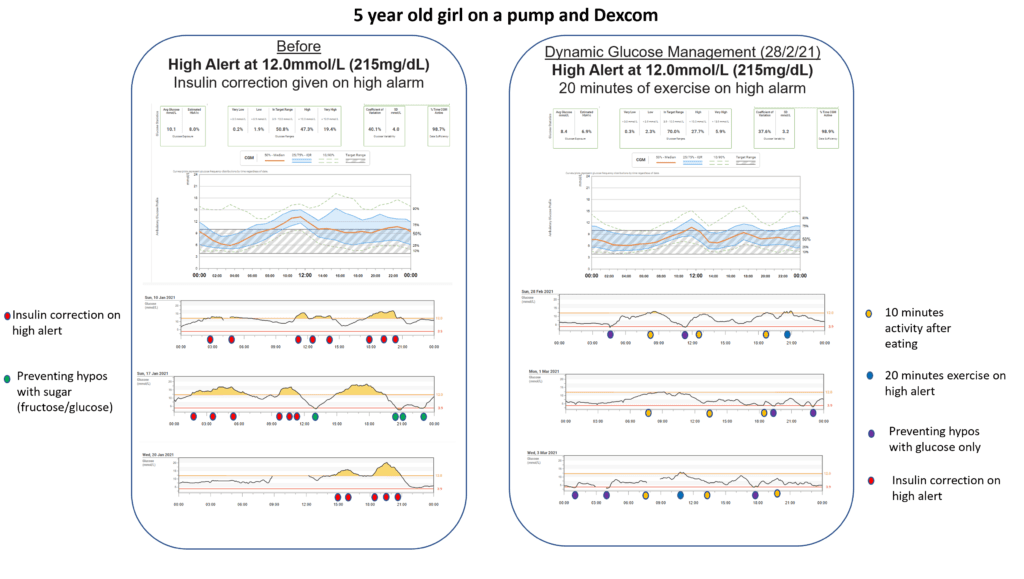
The framework has been taught beyond one person. A CGM structured-education programme built on Dynamic Glucose Management was introduced at Birmingham Children’s Hospital for children, young people and their families, and has been published in the peer-reviewed research record (Pemberton et al., Pediatric Diabetes, 2020); the write-up is available in the Research section. The published programme improved time in range and reduced problematic hypoglycaemia, with the largest gains in those who used the framework most consistently.
The strongest drivers of improvement were the three the framework foregrounds: short bursts of activity to bring between-meal highs down, adjusting pre-meal insulin timing to the glucose value and trend arrow, and treating lows with pure glucose rather than sugar.
What to explore in your own CGM data
The framework gives you the principles; your CGM data shows how they play out for you specifically. A few things worth looking for.
- What does your trace do in the two hours after a large meal, and does a short burst of activity in that window change the shape of the curve?
- How does the size and timing of your pre-meal bolus move the post-meal peak?
- How does your overnight trace differ on nights that follow high activity compared with quieter days?
You may notice patterns that suggest where the framework fits your life and where it needs adapting. That noticing is the work; the data is the feedback.
This content is for educational exploration only. It describes average responses and general principles. It is not medical advice and cannot replace individual clinical guidance from your diabetes care team.
Dynamic Glucose Management Knowledge Check
That was dynamic glucose management: reading your CGM to stay a step ahead. A short assessment on the guide follows, and 9 out of 10 earns your certificate.