
Type 1 diabetes only. This is the Mealtime Insulin Guide hub. Start with this page, then move to the meal type you face most often. The order is recommended — but you can jump to what you need.
Mealtime insulin sequence
- Mealtime insulin guide (hub)
- High-carbohydrate meals
- Balanced meals
- High-fat meals
- Mealtime insulin infographic
What is mealtime insulin?
Mealtime (bolus) insulin is the insulin you use to manage glucose rises from food. Its job is simple in theory: match insulin action to glucose entering the bloodstream.
In practice, it’s one of the hardest parts of type 1 diabetes — because meals are not uniform, digestion is not linear, and injected insulin does not behave like native insulin.
This guide exists to help you dose insulin for real meals, in a way that reduces post-meal spikes, correction loops, and delayed hypos — without turning diabetes into a full-time maths degree.
Why mealtime insulin is hard
If mealtime insulin feels harder than basal or corrections, that’s not a failure of skill — it’s a structural problem.
In people without diabetes, insulin is released directly into the portal vein, reaching the liver first. That early liver signal rapidly suppresses glucose release after eating.
Injected insulin bypasses this system. It reaches the liver later, at lower concentration, and with a fixed absorption profile that doesn’t adapt to the meal in front of you.
So even when the dose is “right”, timing and meal composition can still produce spikes, late drops, or both.
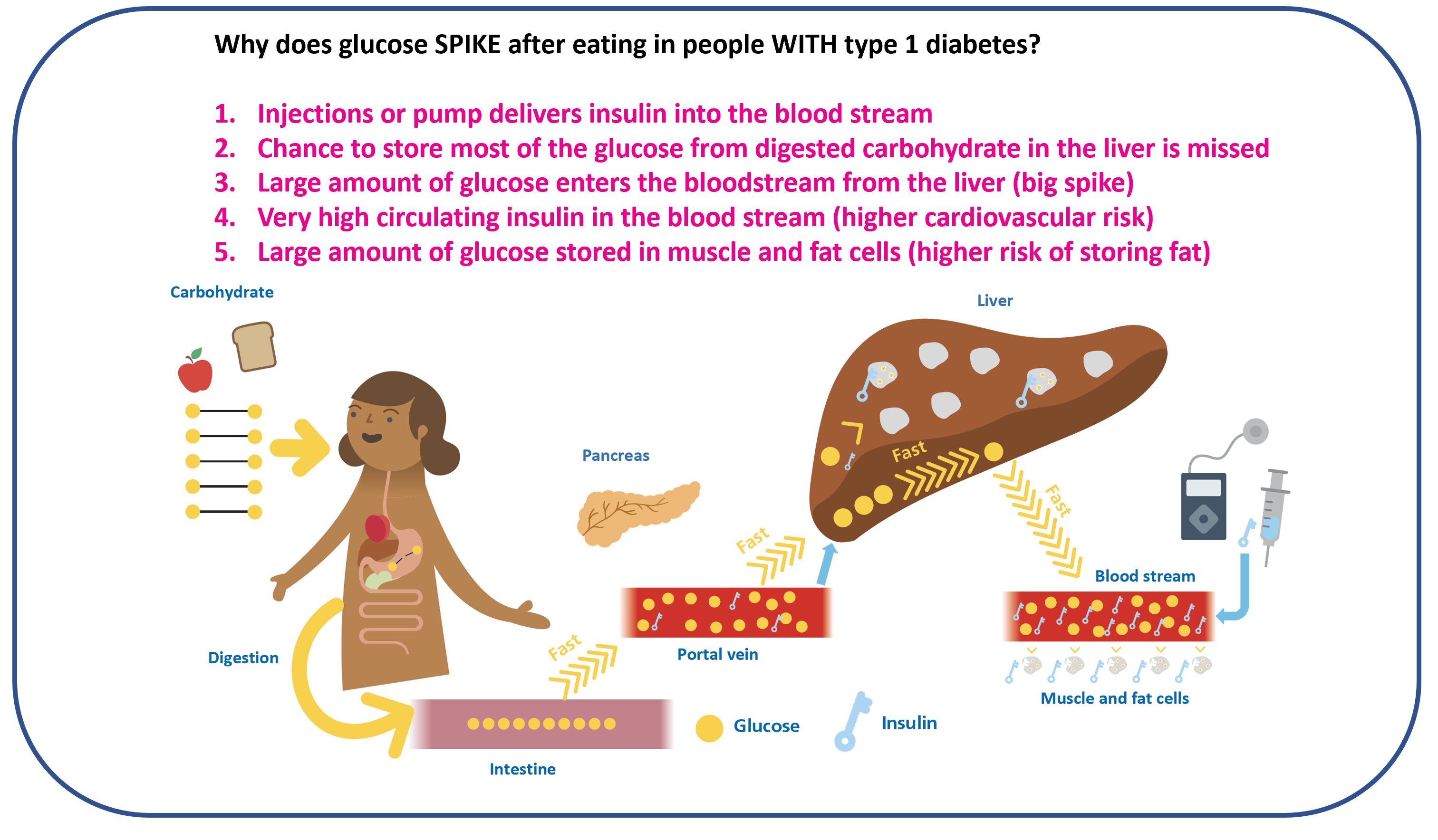
The goal of this guide is not perfection. It’s predictability.
Meals are not all the same
Different meals push glucose in different ways. Trying to dose them all with one mental model is how people end up stuck in correction cycles.
For practical purposes, most meals fall into one of three categories:
- Balanced meals — mixed carbohydrate, protein, and fat
- High-carbohydrate meals — fast glucose, short digestion
- High-fat meals — delayed, prolonged glucose rise
This guide doesn’t ask you to label every meal perfectly. It asks you to pick the category that best matches what you usually eat — and start there.
Practical
Don’t try to apply everything at once.
- Pick one meal type
- Apply it consistently for 1–2 weeks
- Use CGM feedback to adjust
The rest of the site assumes this logic is already in place.
What’snext?
Mealtime insulin / related content
Navigate as you need.
- Mealtime insulin guide (hub)
- High-carbohydrate meals
- Balanced meals
- High-fat meals
- Mealtime insulin infographic
Optional: the experiment path
Some adults choose to explore carbohydrate restriction. If that’s you, this sits outside the core framework — not above it.
If you’re curious, you can see how I approached it here:
120-day carbohydrate experiment
This is optional. Great control does not require extremes.
Mealtime insulin / related content
The order below is recommended, but navigate as needed.