
The GNL Podcast
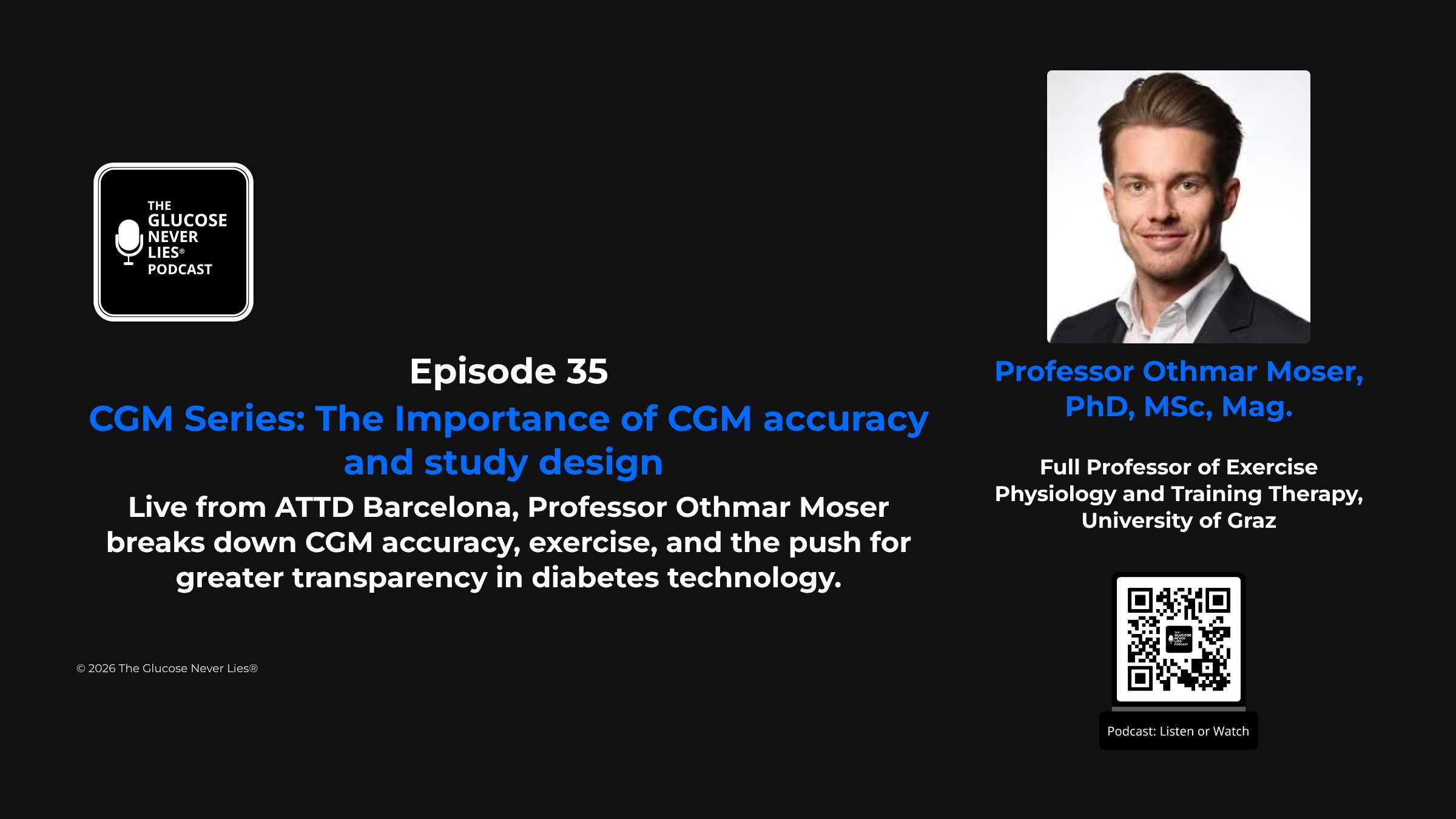
Episode 35 — CGM Accuracy and Study Design with Professor Othmar Moser
Why CGM accuracy numbers only mean something when the study behind them is designed well, and what that means for the insulin dosing decisions people make every day.
Listen
In this episode
CGM accuracy is usually described with a single number: MARD. But a low MARD can hide significant risk if the study that produced it was poorly designed. In this conversation, Professor Othmar Moser explains how study design determines what accuracy numbers actually mean, why meal and insulin challenges are essential for testing CGM in real conditions, and what people with type 1 diabetes and clinicians should look for when comparing devices.
Othmar returns to The GNL Podcast for the second time, having previously joined for Episode 18 on exercise physiology. This episode connects directly to the GNL CGM Guide, adding the research perspective that underpins much of that content.
What this episode explores
- Why CGM accuracy matters when people use sensor glucose values to dose insulin
- What MARD is, how it is calculated, and why it can be misleading when used in isolation
- The five study design questions from the GNL CGM Guide and why they matter
- What 20/20 and 40/40 agreement rates reveal that MARD alone cannot
- Why the difference between peer-reviewed and non-peer-reviewed accuracy data is significant
- What CE marking does and does not guarantee about CGM accuracy testing
- Why meal and insulin challenges are essential for testing CGM under real-world conditions
- How study design quality affects what we actually know about CGM risk
- Professor Moser’s perspective as a researcher who designs and runs these studies
Buzzsprout player
Key themes
1. MARD is useful but incomplete
Mean Absolute Relative Difference (MARD) is the most commonly cited measure of CGM accuracy. It averages the percentage difference between sensor readings and reference blood glucose values. A lower MARD generally indicates better accuracy, but MARD averages can mask wide variability. A sensor with 10% MARD could be consistently close to reference values or wildly scattered with errors cancelling out. The study conditions, population, and glucose range tested all affect the number.
2. The five study design questions determine what accuracy data actually mean
The GNL CGM Guide outlines five questions to ask of any accuracy study: Was the study peer-reviewed? Was it conducted independently or funded by the manufacturer? Were participants challenged with meals and insulin? What glucose ranges were tested? How many participants were included? Othmar explains why each of these questions matters and how studies that skip them tend to produce inflated accuracy claims.
3. 20/20 and 40/40 agreement rates reveal what MARD hides
The 20/20 rule asks: what percentage of readings fall within 20% of the reference value (above 5.6 mmol/L) or within 20 mg/dL (below 5.6 mmol/L)? The 40/40 rule identifies the percentage of readings that fall outside 40% or 40 mg/dL, representing the dangerous tail where dosing decisions based on CGM could lead to significant harm. A sensor might have acceptable MARD but still have an unacceptable 40/40 failure rate.
4. Meal and insulin challenges are not optional
CGM accuracy during stable glucose is relatively easy. The real test comes when glucose is changing rapidly, which is exactly when people need accurate readings to make insulin dosing decisions. Studies that do not include standardised meal and insulin challenges tend to test CGM only in the easy conditions. Othmar explains why this matters and how it affects the real-world relevance of accuracy claims.
5. CE marking does not guarantee adequate accuracy testing
A CE mark confirms that a device meets regulatory requirements for sale in Europe, but the accuracy testing required for CE marking is not always conducted under the same rigorous conditions as independent peer-reviewed research. Many people assume that regulatory approval means accuracy has been thoroughly validated. Othmar clarifies what CE marking does and does not tell you about real-world performance.
6. Peer-reviewed evidence is the gold standard, and much of what is cited is not
Manufacturer-published accuracy data, conference posters, and white papers have not been through the independent scrutiny of peer review. Peer review does not guarantee perfection, but it does mean the methods, analysis, and conclusions have been examined by independent experts. When comparing CGM accuracy claims, the source of the evidence matters as much as the numbers.
7. Study design quality shapes what we know about CGM risk
If accuracy studies are conducted only in stable glucose conditions, with small sample sizes, without independent oversight, and without meal or insulin challenges, the resulting data may look reassuring while saying very little about how the device performs when it matters most. Othmar argues that higher standards for study design are essential for understanding the real risk profile of any CGM system.
8. Accuracy during hypoglycaemia and rapid change matters most
The glucose ranges where accuracy is hardest to achieve are also the ranges where errors carry the greatest risk. Sensor lag, calibration drift, and interstitial fluid delay all tend to be more pronounced during rapid glucose movement. People making insulin decisions during a fall or a spike are relying on the sensor reading at precisely the moment it is least likely to be accurate. Study design that omits these conditions leaves the most important questions unanswered.
9. A researcher’s perspective on improving the evidence base
Othmar shares how his research group designs accuracy studies, what makes a study robust, and where the field needs to move. The conversation explores what independent researchers can contribute that manufacturers alone cannot, and why transparency in study design benefits everyone: people with diabetes, clinicians, and the CGM industry itself.
Practical exploration checklist
For people with type 1 diabetes exploring CGM accuracy:
- When comparing CGM systems, look beyond MARD: ask what study design produced the number
- Check whether accuracy data come from peer-reviewed, independent research or manufacturer-published materials
- Look for 20/20 agreement rates and, critically, the 40/40 failure rate
- Ask whether the study included meal and insulin challenges or tested only stable glucose
- Remember that sensor lag and accuracy limitations are most pronounced during rapid glucose changes, which is when you are most likely to be making dosing decisions
- Use the five study design questions from the GNL CGM Guide as a framework whenever you encounter accuracy claims
For clinicians and educators:
- When recommending or comparing CGM devices, apply the same critical appraisal you would to any clinical evidence
- Help people understand that accuracy is not a single number but a profile that depends on conditions
- Discuss the limitations of sensor glucose during rapid change, particularly for correction dosing and hypoglycaemia detection
- Advocate for higher standards in CGM accuracy reporting and independent verification
This content is for educational exploration only. It describes average responses and general principles. It is not medical advice and cannot replace individual clinical guidance from your diabetes care team.
About the guest
Professor Othmar Moser is based at the Medical University of Graz, Austria, where his research focuses on exercise physiology, CGM accuracy, and glucose metabolism in type 1 diabetes. He is a leading figure in the design and conduct of independent CGM accuracy studies and has contributed to international consensus on how sensor performance should be evaluated. Othmar previously appeared on The GNL Podcast in Episode 18, exploring exercise physiology for people with type 1 diabetes.
Related reading on GNL
- CGM Guide Part 1: How to Choose a CGM
- CGM Guide Part 2: Assessing CGM Accuracy and Performance
- CGM Guide Part 3: CGM Bells and Whistles
- Mastering CGM: 10 Top Tips
- The CGM Black Swan: Pursuit of Simplicity and Asymmetric Risk
- Episode 18: Exercise Without Fear (Professor Othmar Moser)
- Episode 19: iCGM vs eCGM vs Standardisation (Dr Guido Freckmann)
- Episode 20: Standardisation of Testing CGM Performance
Episode navigation
This content is for educational exploration only. It describes average responses and general principles. It is not medical advice and cannot replace individual clinical guidance from your diabetes care team.