
Podcast series
CGM Series: Episodes 10 to 12
Three episodes exploring CGM accuracy, the regulatory landscape, and the unique features of each major CGM system, how to assess what you are using and what the metrics actually mean.
Ask Grace
Want to follow up on anything raised across the CGM series episodes? Ask Grace.
About this series
This is The Glucose Never Lies Podcast CGM Series, a deep dive into CGM systems, how to assess their accuracy, and what the regulatory landscape means for the numbers on your screen. Hosted by John Pemberton and Louise Collins. For the most complete companion resource, explore the CGM Guide.
The series has grown, Episodes 35 and 36
Since Episodes 10-12, the CGM Series has expanded with two further episodes that go deeper into the research and real-world clinical practice behind CGM accuracy:
- Episode 35, CGM Accuracy and Study Design with Professor Othmar Moser
The independent research perspective. Why MARD alone is misleading, how study design determines what accuracy numbers actually mean, why meal and insulin challenges are non-negotiable, and what CE marking does and does not guarantee. The episode that explains the “why” behind every study design question in the framework above. - Episode 36, CGM Accuracy: DSN Forum
The clinical application. Amanda Williams, Beth Kelly, and Tamsin Fletcher-Salt (DSN Forum UK) explain how the DSN Forum comparison chart was built, why data sufficiency must come before features, what they are seeing in UK clinical practice, and what ATTD 2025 revealed about fully closed loop systems, GLP-1 in type 1 diabetes, and continuous ketone monitoring. The episode that shows how the framework translates into real-world device selection and patient conversations.
Episode 10: CGM Accuracy, study design first, performance after
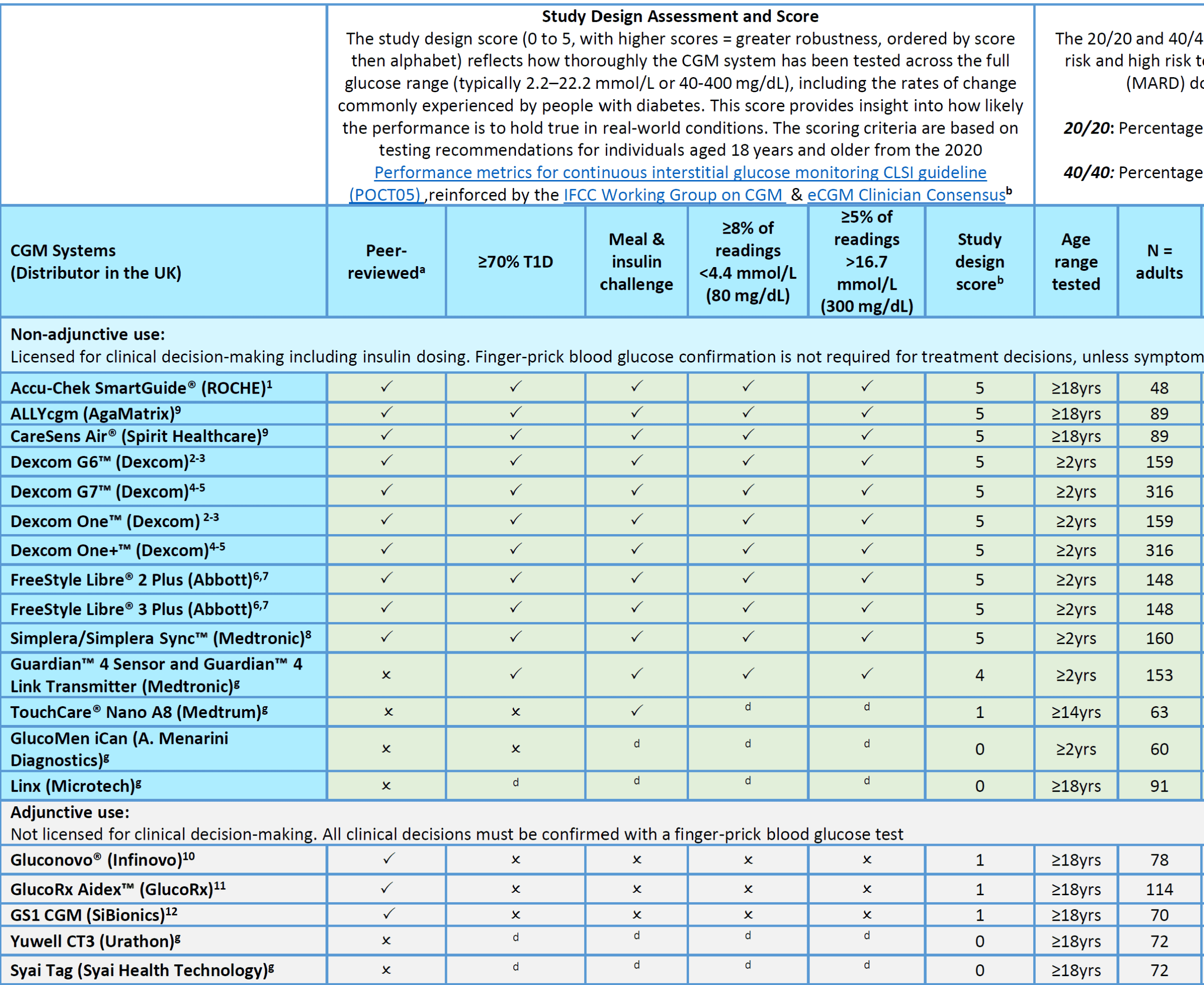
John Pemberton and Louise Collins explore the importance of understanding CGM accuracy, why study design must be assessed before performance data, and the key questions to ask when evaluating sensor reliability. The conversation covers what robust testing conditions look like, why not all CGMs are equal, and what standardisation in CGM technology may look like in the future.
This chart, developed in collaboration with the DSN Forum UK, helps the community understand study design before considering performance. It is updated every two months.
View the updated CGM comparison chart from the DSN Forum UK
Key takeaways from Episode 10:
- Continuous glucose monitors are crucial for insulin dosing decisions
- Understanding study design is essential before evaluating CGM accuracy
- Not all CGMs are created equal, performance varies significantly between devices
- Key questions include the study population, testing conditions, and comparator used
- Robust testing conditions are necessary for reliable sensor performance data
- Peer-reviewed data matters more than marketing claims
- Standardisation in CGM technology is on the horizon via the IFCC ISO process
Episode chapters: 00:00 Introduction | 02:14 Understanding CGM | 05:11 Accuracy overview | 10:13 Evaluating sensor performance | 15:45 Key questions for accuracy | 20:31 Towards standardisation | 25:03 Summary
Episode 11: CGM Accuracy, understanding MARD, 20/20, 40/40, and error grids
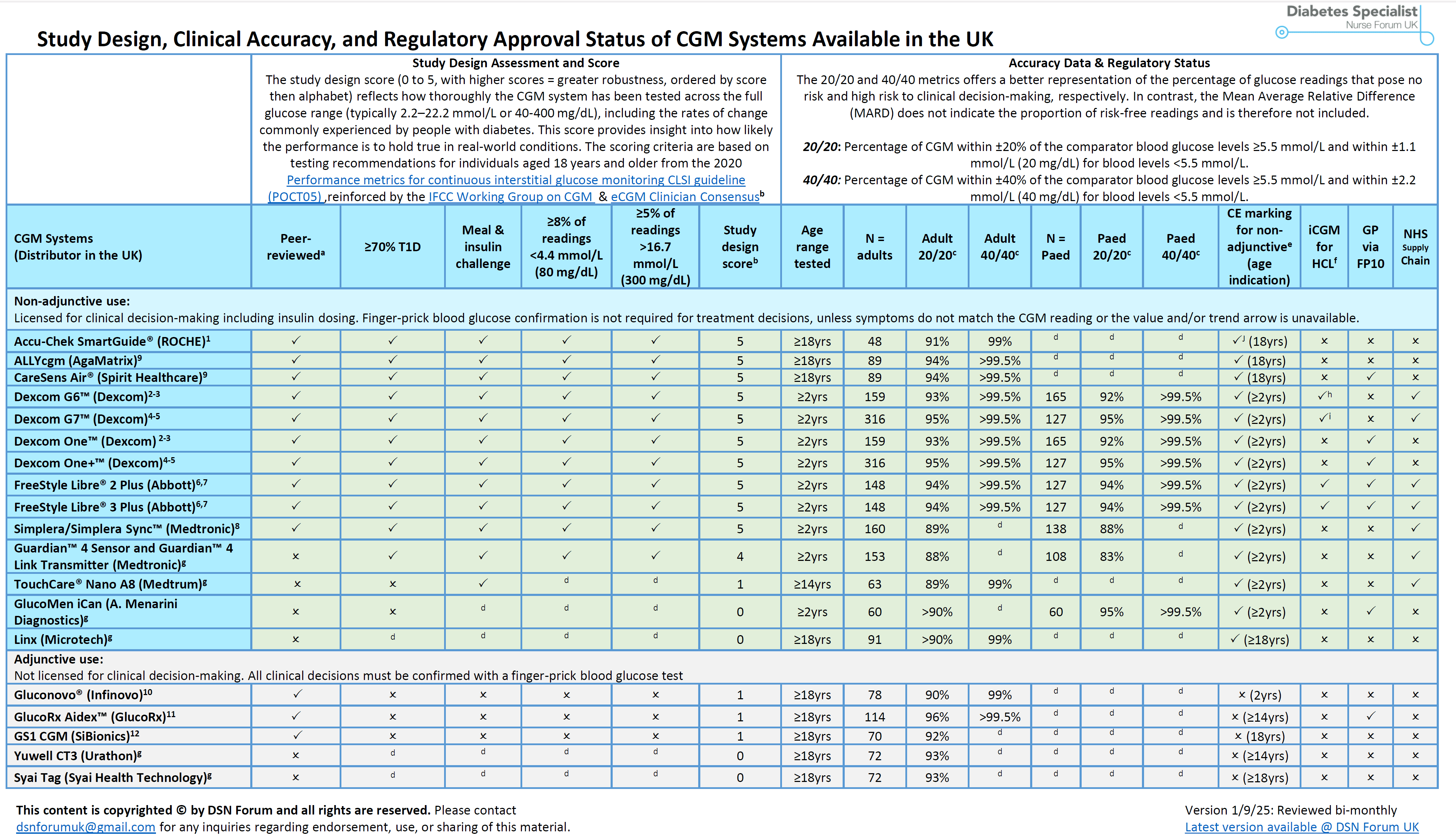
John and Louise explore the metrics used to assess CGM performance: Mean Average Relative Difference (MARD), 20/20 agreement rates, 40/40 agreement rates, and error grids. The conversation covers why FDA standards are currently the highest for CGM performance, why CE marking does not guarantee accuracy, and why testing against capillary glucose matters.
View the CGM performance comparison chart from the DSN Forum UK
Key takeaways from Episode 11:
- FDA standards are currently the highest available for CGM performance
- CE marking does not guarantee device accuracy or reliability
- Testing conditions significantly impact CGM accuracy results
- The 20/20 standard indicates no risk for insulin dosing decisions at a given reading
- The 40/40 metric identifies high-risk readings in CGM data
- Testing against capillary glucose is essential, venous comparators underestimate post-meal glucose exposure
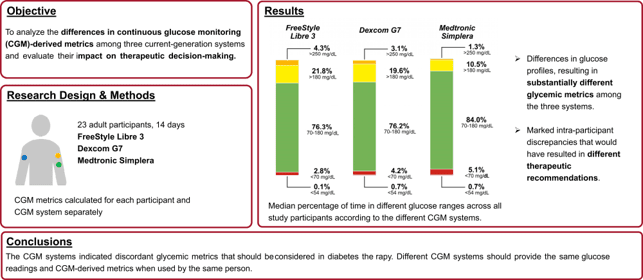
The chart below illustrates a key finding from a comparative study of glycaemic metrics: the Medtronic Simplera aligns more closely with venous glucose values rather than capillary, leading it to underreport post-meal glucose exposure. The Dexcom G7 and FreeStyle Libre 3 track more closely to capillary glucose, giving users a more accurate picture of actual glucose exposure and future complication risk.
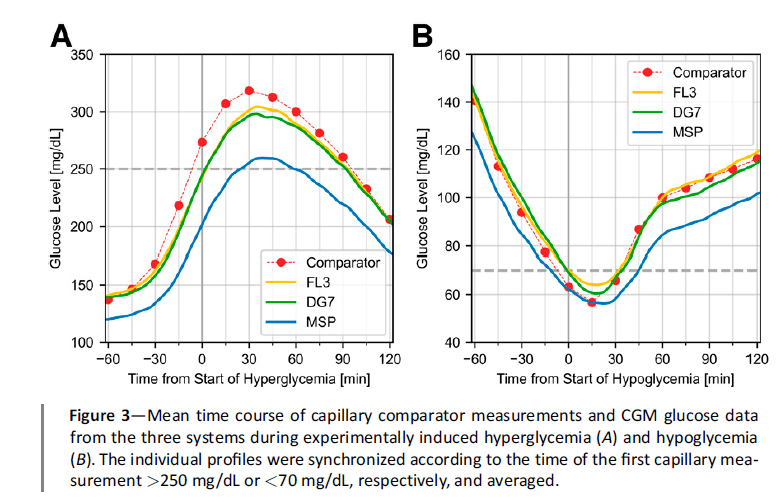
The consequence is that the Medtronic Simplera tends to overestimate time in range and underestimate time above range, users may believe their glucose control is better than it is, only to see HbA1c results higher than expected. Users of the Dexcom G7 and FreeStyle Libre 3 receive a more accurate reflection of capillary glucose levels.
Episode chapters: 00:00 Introduction | 02:07 CGM systems overview | 06:08 Accuracy and performance standards | 10:09 Testing conditions | 14:13 Metrics for accuracy | 18:03 Comparing against capillary glucose | 22:02 Future directions
Episode 12: CGM functionality, the bells and whistles
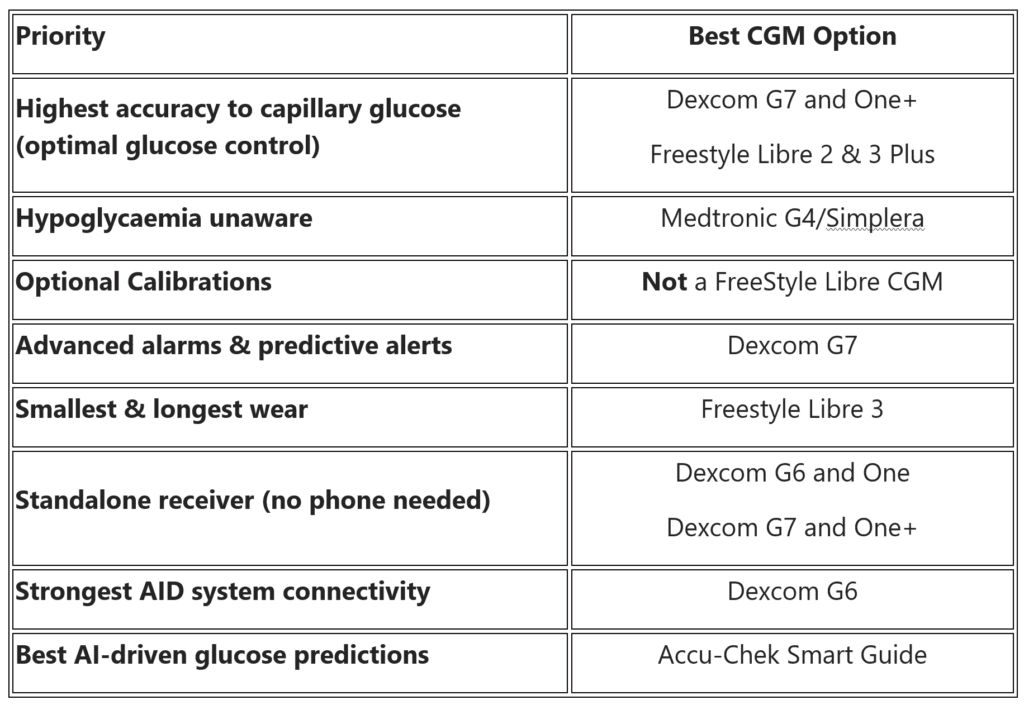
John and Louise explore the features that distinguish CGM systems from each other: calibration options, alarm types and thresholds, size and wearability, connectivity with AID systems, and AI-driven forecasting. The emphasis is on understanding individual priorities and matching them to the right system, because there is no one-size-fits-all.
This summary table from the CGM Systems Guide helps match the right system to the right priorities.
Key takeaways from Episode 12:
- Modern CGMs now use factory calibration, removing the need for routine finger prick calibration
- Optional calibration can be beneficial, but only when using an accurate blood glucose meter
- Alarm fatigue is a real barrier to effective diabetes management, alarm settings need personalisation
- The FreeStyle Libre is noted for its small size and long wear time
- Dexcom products offer the most extensive connectivity with AID systems
- Understanding individual needs is crucial when selecting a CGM
- AI-driven glucose forecasting in CGMs can support more proactive decision-making
Episode chapters: 00:00 Introduction | 02:14 CGM overview | 13:09 Features and alarms | 21:27 Size and connectivity | 27:21 The wrap
Share and stay in touch
If someone comes to mind who might benefit from this series, please share it. Feedback on what landed well and what could be improved is always welcome.
This content is for educational exploration only. It describes average responses and general principles. It is not medical advice and cannot replace individual clinical guidance from your diabetes care team.