
CGM Device Guide and Teaching Resource
Roche Accu-Chek SmartGuide
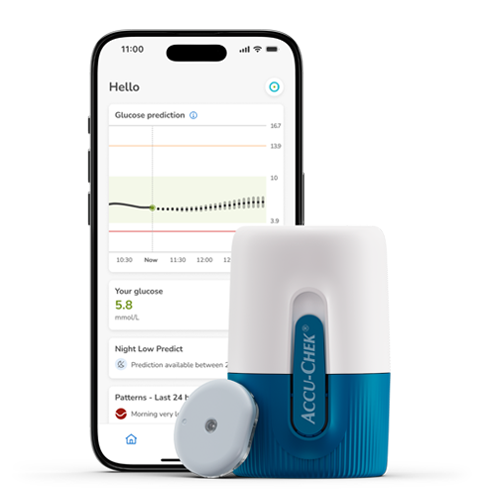
Three layers of glucose prediction, a 30-minute hypo alert, a 2-hour forecast curve, and an overnight risk score, make the SmartGuide the only CGM in this cluster built for forecasting rather than reporting. Strong hypoglycaemia-range accuracy backs it up: 94.3% within ±20/20 below 3.9 mmol/L, SmartGuide’s own best sub-range.
Ask Grace
Want to explore what the SmartGuide predictions mean in your own data? Ask Grace.
Roche Accu-Chek SmartGuide at a glance
- ±20/20 agreement: 91% (DSN Forum UK comparison chart, N=48); 90.5% in-clinic pivotal-table cut of the same study (Mader 2024)
- Strongest in hypoglycaemia: 94.3% within ±20/20 below 3.9 mmol/L, SmartGuide’s own strongest sub-range, unusual since many CGMs perform worst in the low range
- Three prediction layers: a 30-minute hypo alert, a 2-hour glucose forecast curve, and an overnight risk score, the only CGM in this cluster with a labelled predictive layer
- Wear and calibration: up to 14 days, two paired finger-prick calibrations on day one, factory-style thereafter
- Age indication: 18 years and older, adults only
- AID compatibility: none confirmed at this time
Framework status
Data sufficiency: Met. Mader et al. 2024, Journal of Diabetes Science and Technology, n=48, 139 sensors analysed across three German and Austrian sites. 48 participants sits at the lower bound of the threshold; the three-sensor-per-participant design supports the analysis.
First UK clinical evaluation. Amy Jolley, Lead Educator at the Diabetes Technology Network UK and lead for the Young Adult and Transition Service at Salford NHS, put 17 people onto the SmartGuide in a single week in May 2026 in a structured group evaluation, the first of its kind in the UK. The structured-onboarding format produced a teaching opportunity around day-one calibration and surfaced lived-experience observations on the prediction layers in real-world use.
Using your Accu-Chek SmartGuide day to day
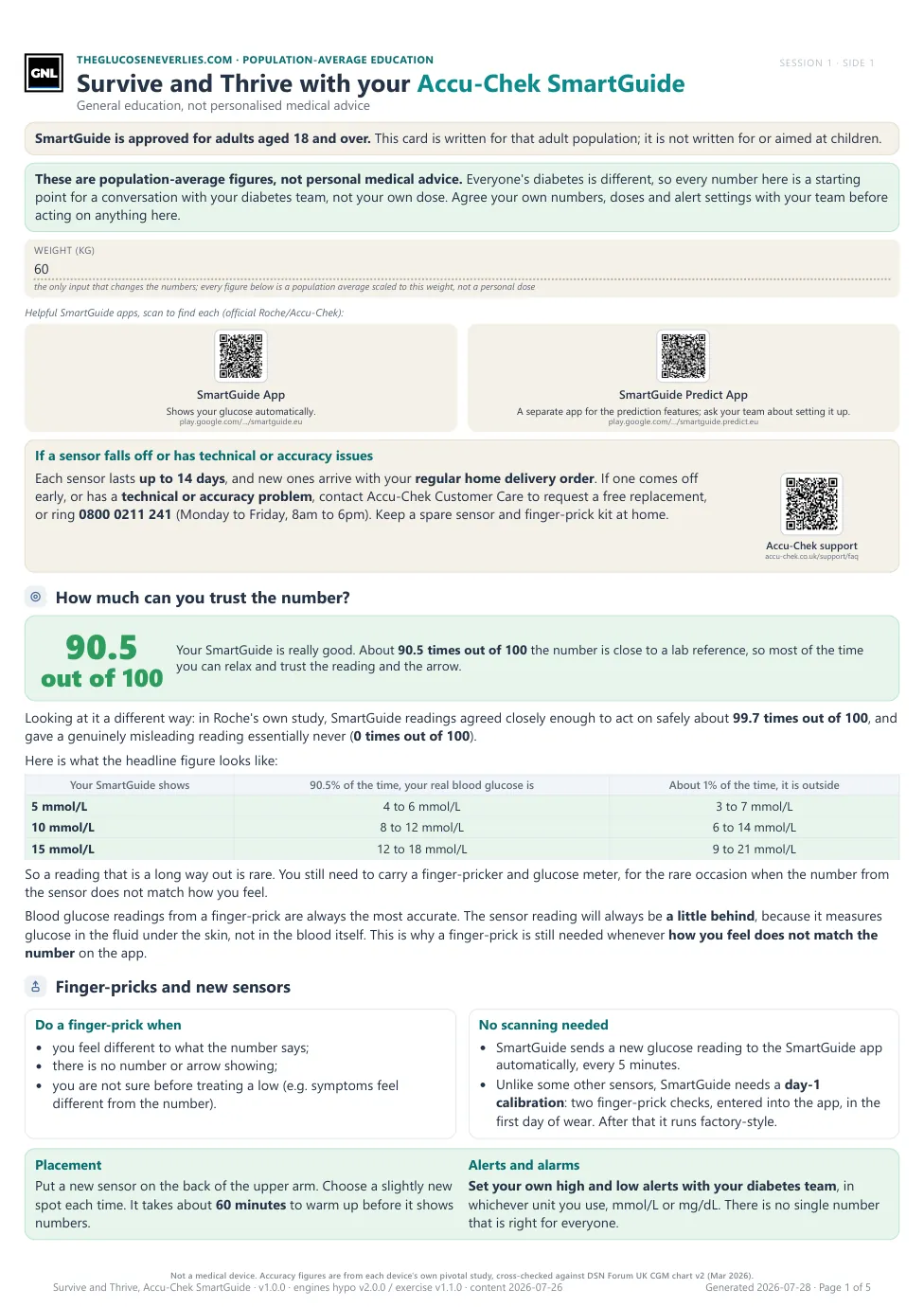
Reading a sensor is the easy part. Knowing what to do when it alarms before breakfast, or what to give before PE on a wet Tuesday, is the part that takes practice. Survive and Thrive is a short practical guide to using your Accu-Chek SmartGuide in the situations that actually come up, written to be printed and kept where it is needed rather than read once and closed.
SmartGuide hands you more to read than most sensors do, which makes choosing what to teach first harder rather than easier. That choice rests on over a decade of paediatric clinic work. The guide carries the minimum effective dose, the parts that change what you actually do, and leaves the rest of the detail on this page for whenever you want it.
Why it is called Survive and Thrive. Any new device goes the same way round. There is a small set of survival rules that keep you safe while the rest is still unfamiliar, and there is everything else, which can wait. The guide teaches the survival part first: the low, the high and its ketones, the moments a reading deserves a second look. Thriving is what follows once that is second nature, and it is where most of the day to day value sits. That order comes from the published evidence and from clinic experience of what people can take on and when. A little personalisation is built in too: the carbohydrates you keep to hand are yours to choose, and Grace will scale the figures to a weight you enter.
Make one with your own weight in it
The guide below is a worked example at 60 kg; you can build your own with your weight and the carbohydrates you keep to hand, scaled from the same population averages.
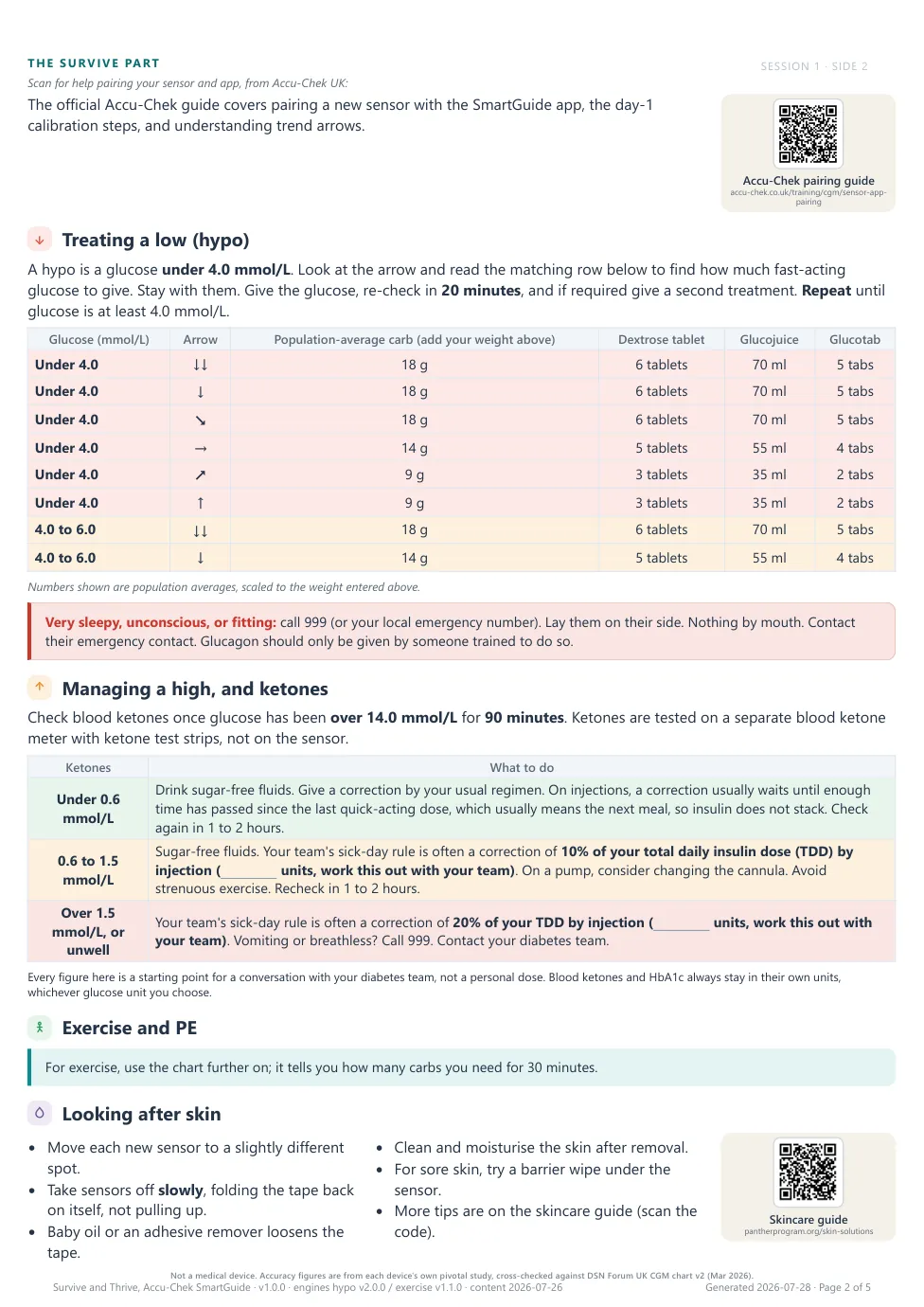
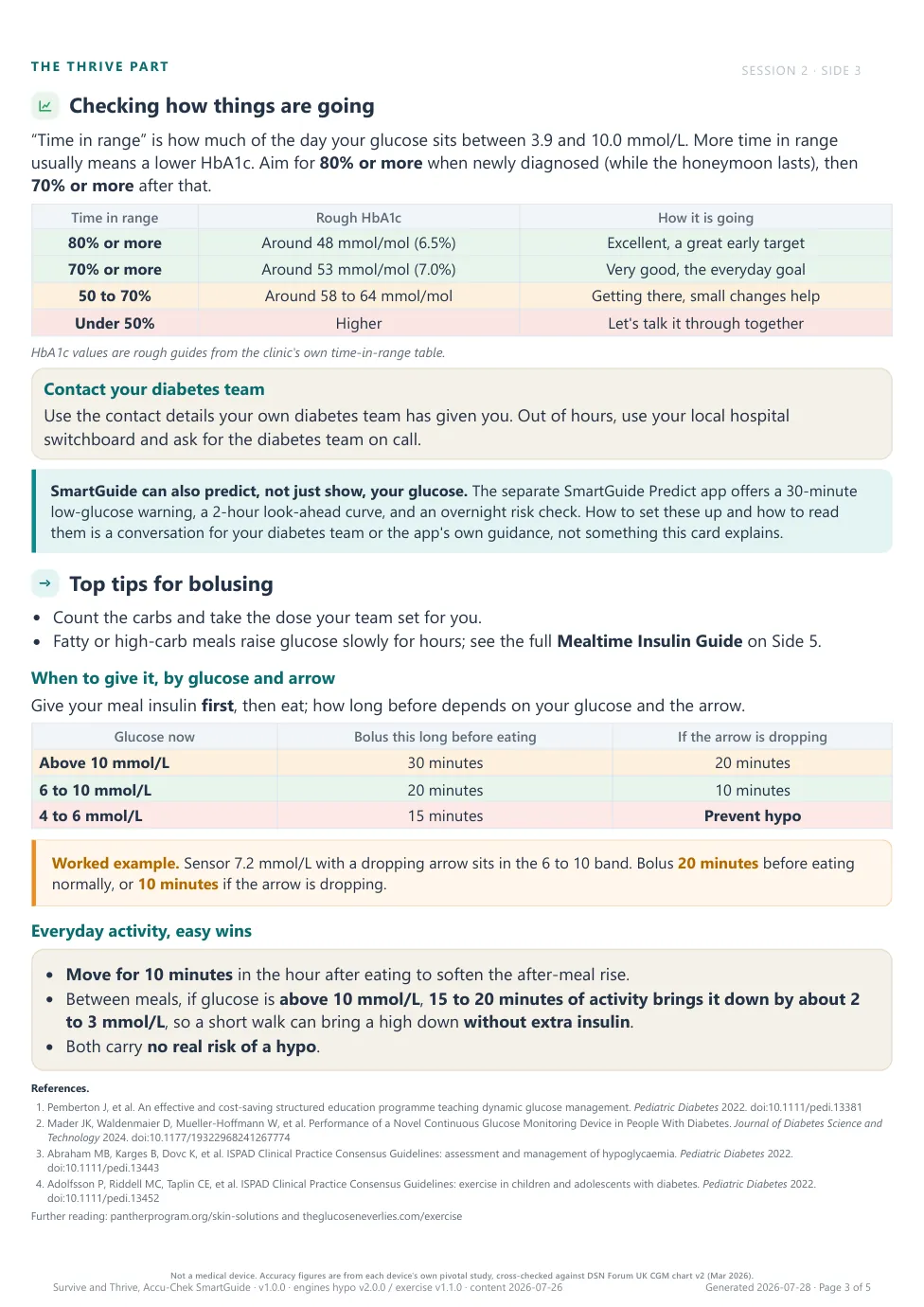
How to use your Accu-Chek SmartGuide, the one-page guide
What it walks you through.
- Treating a low. Reading the glucose and the trend arrow together, and what that points to in grams of fast-acting carbohydrate, with the re-check timing.
- Highs and ketones. When a high has gone on long enough to check ketones, and what each ketone band means.
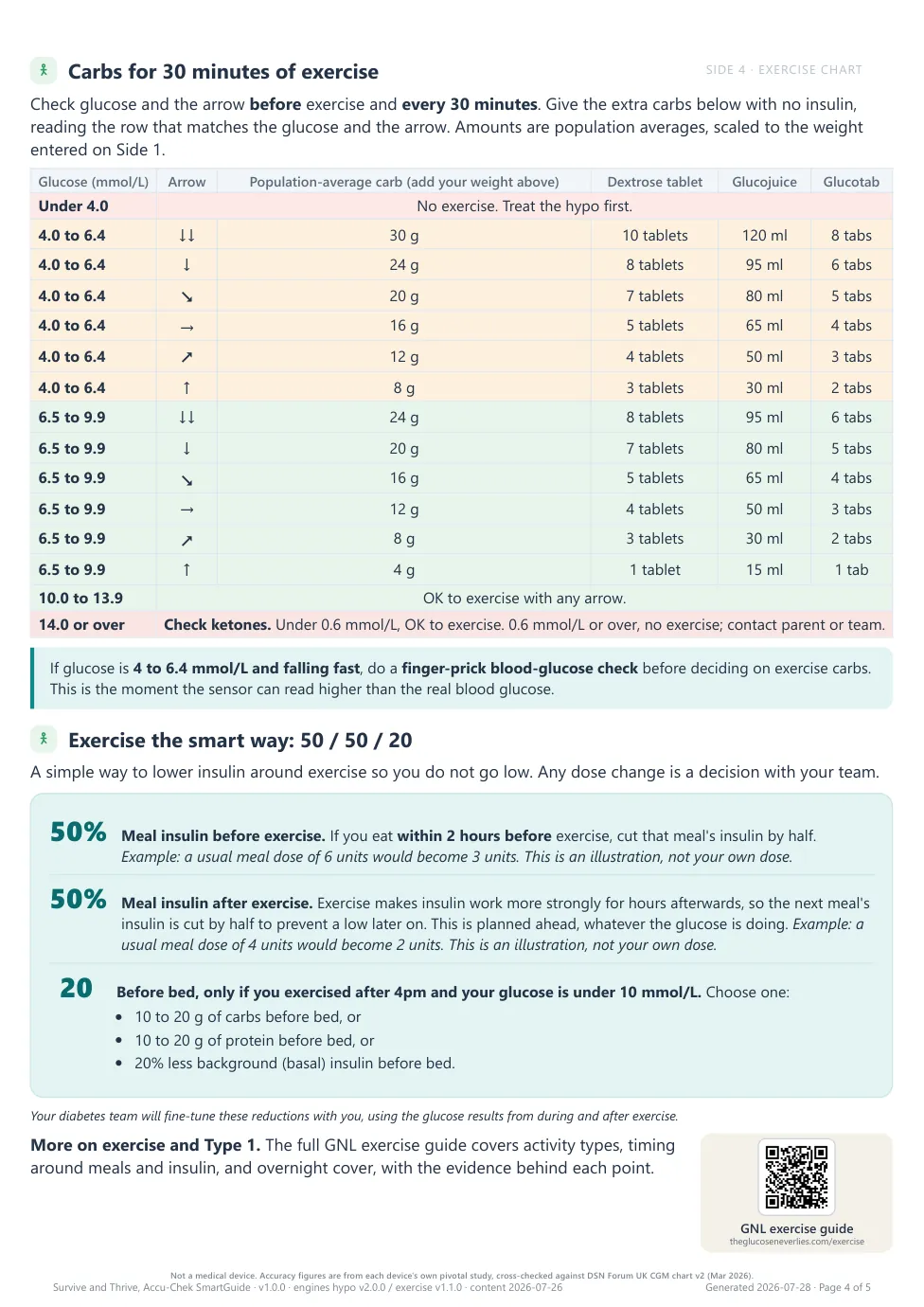
- Exercise. Carbohydrate for thirty minutes of activity, read off the same glucose-and-arrow pair, plus the insulin planning around it.
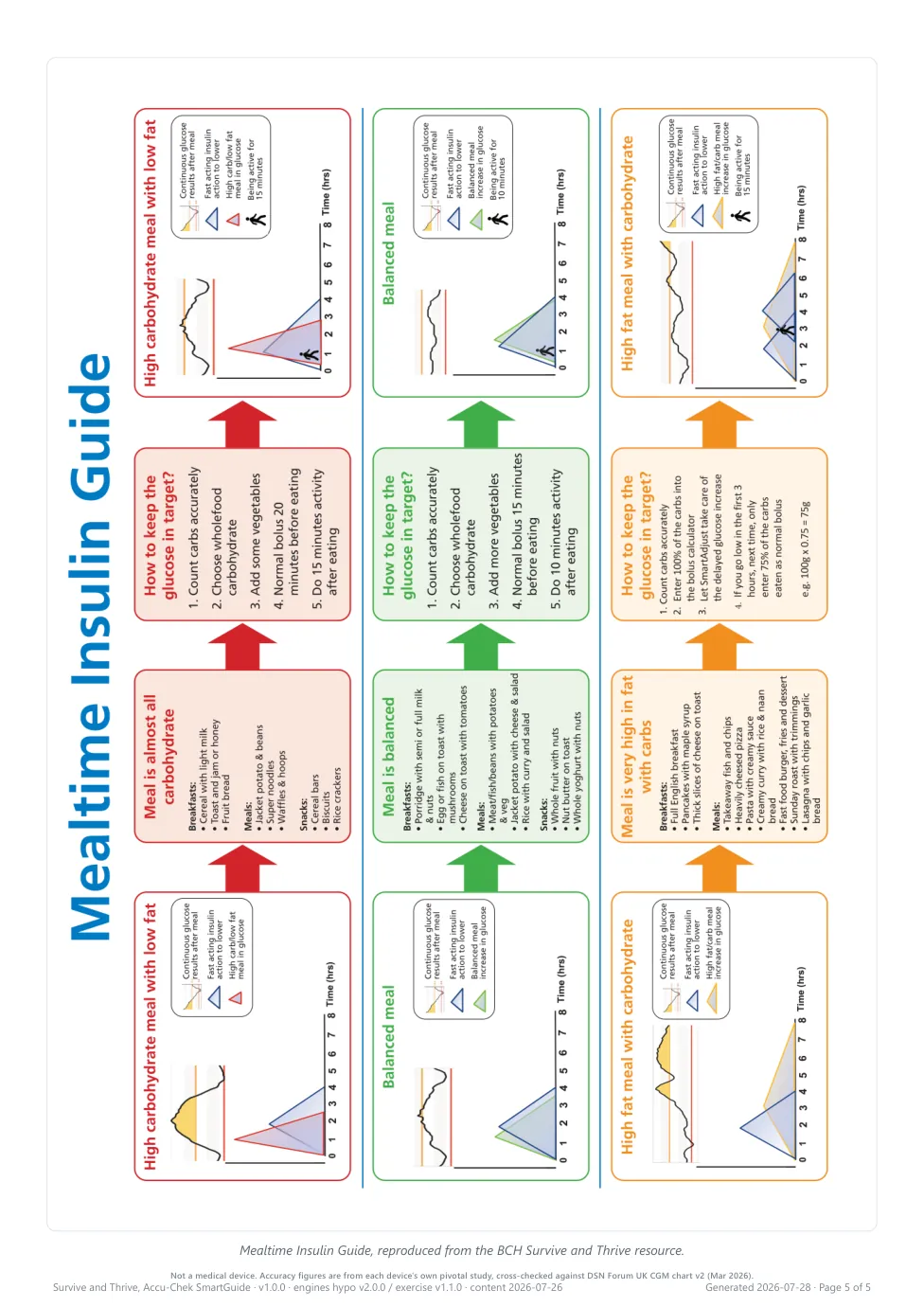
- The everyday things. When a finger-prick still matters even with a sensor on, looking after the skin underneath, and how mealtime insulin timing shifts with the arrow.
Two things worth knowing before you print it. The carbohydrate tables let you choose the three products you actually keep to hand, so the grams come out as that many tablets, millilitres or sweets rather than as a number to convert under pressure. And the trend arrows are drawn the way this sensor draws them, so the row you are looking for on paper matches the glyph on the screen.
Every figure on it is a population average scaled to a body weight. It is a starting point for a conversation with your diabetes team, not a personal dose, and the card says so on every side.
Device specifications
The headline numbers sit in the framework card above. The full device profile is here for anyone who wants the detail.
Full device profile
Manufacturer: Roche Diabetes Care GmbH, Mannheim. Family: Accu-Chek SmartGuide CGM device, SmartGuide app, SmartGuide Predict app, AC Care HCP platform. CE marked: July 2024, MDR class IIa. UKCA non-adjunctive: MHRA, May 2025, 18 years and older. Wear duration: up to 14 days. Application site: back of the upper arm. Sensor profile: 5.9 mm height with adhesive, 5 g, 33.3 mm diameter on skin (Glatzer 2024). Reading interval: every 5 minutes via Bluetooth Low Energy. Run-in: one hour. Calibration: two paired finger-prick calibrations on day one (around 12 and 14 hours after insertion); factory-style operation thereafter. Display: Accu-Chek SmartGuide app on iOS and Android (no dedicated reader). Indication: non-adjunctive (no confirmatory finger-prick required for insulin dosing once calibration is complete). Age indication: 18 years and older. Hospital use: not intended.
The Predict app, separately. A second app, the Accu-Chek SmartGuide Predict app, is CE-marked MDR class IIa medical software in its own right. It carries the three prediction layers (30-minute, two-hour, overnight) and runs as cloud-supported inference on iOS and Android. The CGM app and the Predict app are distinct downloads with shared data flow.
The day-one calibration reads like a step backwards next to a factory-calibrated sensor, and in a rushed appointment it can land that way. Given time and a group setting, it tends to do the opposite: two finger pricks on day one is often the first honest conversation a long-time CGM user has had about finger-prick testing in years.
Accuracy
GNL leads accuracy comparisons across this cluster with the DSN Forum UK comparison chart, the house standard for CGM accuracy figures: SmartGuide’s ±20/20 agreement rounds to 91% on that chart (N=48). That chart figure and Mader and colleagues’ (2024, Journal of Diabetes Science and Technology) published in-clinic pivotal-table cut, 90.5% within ±20/20, are two cuts of the same study, not two studies; Mader 2024 also reported 1.2% outside the ±40/40 safety band. The hypoglycaemia-range agreement (94.3% within ±20/20 below 3.9 mmol/L) is the strongest sub-range performance and a meaningful differentiator, since many CGM systems perform worst in the low range. The reported positive bias of approximately 11% below 3.0 mmol/L is worth knowing: a sensor reading of 4.5 may correspond to a slightly lower true value, so hypoglycaemia thresholds should not be relaxed on the assumption that the sensor over-reads. Cross-CGM agreement comparisons need a comparator-equivalence note: the SmartGuide pivotal used capillary blood (Accu-Chek Guide), Dexcom and Libre pivotals used venous YSI; comparator choice can shift apparent agreement by several percentage points. The full thesis lives on the accuracy page.
| Metric | Accu-Chek SmartGuide |
|---|---|
| Framework score | 5/5 |
| ±20/20 agreement | 91% adults (n=48); no paediatric figure, the device is not studied in children |
| Outside ±40/40 | About 1% (the chart reports 99% within ±40/40, n=48); 1.2% in Mader 2024’s own published cut, the same study computed differently |
| Evidence source | DSN Forum UK CGM Comparison Chart v2 (March 2026), ref 1, the house standard for CGM accuracy figures; underlying pivotal Mader et al 2024, Journal of Diabetes Science and Technology, n=48, 139 sensors, capillary comparator (Accu-Chek Guide, ISO 15197:2013), Roche-authored and Roche-funded |
91% within ±20/20 reads lower than the headline figures on the other devices in this cluster, and it is worth explaining why rather than letting the number sit unexplained: a capillary comparator against a venous one is not a like-for-like measuring stick, and SmartGuide’s own strongest suit, hypoglycaemia-range accuracy, is where it matters most day to day.
Three prediction layers
Three independent machine-learning models packaged into the Predict app (Herrero et al. 2024, Journal of Diabetes Science and Technology): a 30-minute hypo classifier, a two-hour glucose curve, and an overnight risk score. The framing matters. None of these prevents an event; each gives an earlier window to act.
Predicts the night, no AID partnership. The overnight risk score is the only one of its kind in this cluster. The trade-off the page sits on is between proactive overnight protection and access to algorithm-driven insulin delivery: SmartGuide does not yet pair with Omnipod 5, Tandem Control-IQ, CamAPS FX, or the MiniMed 780G. The prediction layers do not see exercise, alcohol, illness, or future meals or insulin doses; they are reactive to the data the user logs.
“Do not oversell the two-hour accuracy.”
John Pemberton, GNL Podcast Episode 40. The 45-minute window is the action window; the 45-minute to 2-hour stretch is awareness, not action. Parkes A+B agreement on the 2-hour Glucose Predict curve: 99.3% at 45 minutes, 96.3% at 2 hours (Herrero 2024).
What the layers do not do. They do not see exercise, alcohol, or illness. They do not anticipate meals or insulin doses the user has not entered. The Night Low Predict model does not catch every overnight low; for the pre-bedtime prediction the published figure is about 55 of every 100 real overnight hypoglycaemia events at the stated threshold. That is why the 30-minute Low Glucose Predict alarm is the active safety net during the night, and why the overnight score is not a substitute for it. Honest framing, in line with Roche’s own published descriptions: these layers reduce the likelihood of a low and give a window to act before one. They do not prevent.
What 17 people reported in the first UK clinical evaluation
Amy Jolley, Lead Educator at the Diabetes Technology Network UK and lead for the Young Adult and Transition Service at Salford NHS, put 17 people onto the SmartGuide in a single week in May 2026 and asked them to come back and report what happened. Two findings shaped the teaching order. First, the day-one calibration did not cause friction; it gave clinicians a concrete reason to re-establish the value of finger prick testing in a group setting. Second, two of the 17 reported stopping post-meal correction boluses entirely after seeing Glucose Predict show the glucose already coming down. The double-arrow-up reflex, the impulse to bolus immediately on a high reading, is one of the most persistent frustrations in T1D self-management, and the 45-minute action window from Glucose Predict gives a reason to wait.
Two out of seventeen people is a genuinely small number to build a teaching point on, and it is reported here as exactly that, an anecdotal-clinical observation, not a trial finding. What makes it worth repeating anyway is the mechanism it points at: a 45-minute action window is long enough to change a reflex, which is a different kind of claim to an accuracy percentage.
Teaching the three prediction layers
A clinic-ready breakdown of what each layer does, what it does not do, when to teach it, and what to do when it fires. Open each layer in turn; the order below is the order the wearer should meet them in their first onboarding session. For the printable A4 version that drops into a group session pack, use the link below.
Open the printable A4 teaching resource
Layer 1, Low Glucose Predict, 30-minute hypo classifier (the active safety net)
What it does. Classifies the next 30 minutes as high-risk or not for hypoglycaemia. When high-risk, an alarm fires on the SmartGuide app.
What it does not do. It does not predict the size or depth of the low; it does not catch every event. It is reactive, not preventive.
When to teach it. First. This is the active safety net the wearer relies on while learning the longer-horizon layers.
What to do when it fires. This layer routes into the hypo plan the person already has agreed with their care team; it does not replace that plan or add to it. A finger prick confirms an uncertain reading, and the 30 minutes the alarm buys is what makes the next half hour plannable: driving, a meeting, sleep. The plan’s own re-check timing is what closes it out.
Pitfall. Wearers who silenced “predictive low” alerts on previous CGMs because they fired too often. The SmartGuide LGP fires meaningfully less; ask them to keep it on for two weeks before deciding.
Layer 2, Glucose Predict, 2-hour forecast (action plus awareness)
What it does. Projects a glucose trace 2 hours forward, with a 50% confidence band drawn around it. Refreshes every 5 minutes.
What it does not do. It does not see meals or insulin doses the wearer has not entered. It does not account for alcohol, exercise, or illness. A wide band means low confidence.
When to teach it. Second. Frame it as “the curve you plan around for the next hour, the curve you act on for the next forty-five minutes”. The split is the teach. Parkes A+B agreement is 99.3% at 45 min and 96.3% at 2 hours (Herrero 2024).
What to do when it lights up. 0 to 45 min, the accuracy is good enough for the curve to inform a decision (Parkes A+B 99.3% at 45 minutes); what that decision is stays inside the person’s usual plan with their care team. 45 min to 2 h, the curve is directional rather than decision-grade (96.3% at 2 hours), so it is useful for planning around: meeting timing, a drive, an exam, a run.
Pitfall. Selling the 2-hour mark as reliable. It is not. Wearers who treat the 2-hour endpoint as actionable will be disappointed quickly, and that disappointment is the form factor of a sensor falling out of routine wear.
Layer 3, Night Low Predict, 9pm-to-2am overnight risk score
What it does. Issues a pre-bedtime estimate of the probability of overnight hypoglycaemia, callable between 9pm and 2am. Uses up to around 28 days of the wearer’s own CGM, insulin, and carbohydrate data to shape each prediction; the underlying model itself is population-trained, not personalised at the parameter level.
What it does not do. It is a population-level confidence band, not a personal probability. It does not catch every overnight low: for the pre-bedtime prediction, the published figure is about 55 of every 100 real overnight hypoglycaemia events at the stated threshold, which is why LGP remains the active safety net during the night.
When to teach it. Third. The wearer should already trust the LGP alarm and the GP curve. The night plan is what unlocks confidence to sleep.
What to do with a raised estimate. First half of the night (model ROC AUC 0.902, higher confidence): the signal is strong enough to justify an overnight plan agreed in advance with the care team. Second half of the night (ROC AUC 0.730, lower confidence): the model is less certain, and this half belongs in that same conversation rather than being treated as a firm alert. What the plan contains, fast-acting carbohydrate, slower-releasing options, or a basal change for pump users, is the care team’s call with the person, not a decision taken at the bedside from the score alone.
Pitfall. Treating both halves of the night identically. The ROC AUC asymmetry means a raised-risk estimate at 1am and one at 4am are not the same signal. Land that at onboarding.
Practical exploration
For people living with type 1 diabetes and their families
The SmartGuide rewards a 28-day onboarding pattern that current CGM marketing does not always reflect.
- Night Low Predict draws on up to around 28 days of your own data to shape its predictions; the model itself is population-trained, not learning or adapting to you specifically. The first few weeks may be less reliable while that data builds up; do not draw conclusions from the first night.
- A raised estimate is a prompt to use the overnight plan you have already agreed with your care team, not a prompt to work one out at bedtime. The two halves of the night are not the same signal, and that is the part worth taking to your team: the model is markedly more certain about the first half than the second (ROC AUC 0.902 against 0.730). Ask your care team what your plan should say for each half, and what it should say about fast-acting carbohydrate, slower-releasing options, and basal insulin if you use a pump. The score is not a complete net either; it does not flag every overnight low, which is why the 30-minute Low Glucose Predict alarm stays on through the night.
- You can call up a fresh Night Low Predict estimate again later in the 9pm to 2am window.
- The 45-minute Glucose Predict window is more reliable than the two-hour window (Parkes A+B 99.3% at 45 min vs 96.3% at 2 hours; Herrero 2024). Confidence falls as the horizon lengthens, so the 45-minute point and the two-hour point are not the same quality of signal.
- The predictions do not account for alcohol, exercise, or illness. Adjust your interpretation if any of these applies.
- If the worm is wide at two hours, confidence is lower. Do not treat it as a reliable forecast.
- The two day-one finger pricks (at approximately 12 and 14 hours after insertion) take a few minutes each and activate the full predictive features. Good hand washing and technique matter.
For clinicians and educators
The teaching shape of the SmartGuide differs from a standard CGM in ways that matter at the first appointment.
- Teach the first-half versus second-half distinction for Night Low Predict from the outset. The model’s ROC AUC is meaningfully higher for first-half risk than second-half (0.902 vs 0.730; Herrero 2024).
- Group onboarding sessions generate richer learning than one-to-one. The calibration conversation lands differently when people hear from peers who still finger prick routinely.
- The mandatory day-one calibration is an opportunity to re-establish the value of finger prick testing, not a device drawback.
- Send people away to use it and come back to report. The most useful education comes from early adopters describing what they actually did, not from the manual.
- Current indication is adults 18 and older only. No paediatric licence and no AID compatibility in current form.
- The DTN Competency Assessment Framework, discussed on GNL Podcast Episode 40, is being uploaded to the DTN website shortly; per that conversation it maps team skill mix against a four-tier national standard and links to annual appraisal documentation.
AID system compatibility
The SmartGuide does not currently pair with any AID system. For people on or considering Omnipod 5, Tandem Control-IQ, CamAPS FX, or the MiniMed 780G, the device choice is currently driven by the AID system first. The CGM Guide hub carries the AID compatibility overview across the cluster.
What SmartGuide brings beyond accuracy
Strong hypoglycaemia-range accuracy
The 94.3% within ±20/20 below 3.9 mmol/L (Mader 2024) is SmartGuide’s own strongest sub-range, and is unusual: many CGMs perform worst in hypoglycaemia. No head-to-head accuracy data against the other devices in this cluster exists yet under the same comparator, so this is a within-device finding, not a cross-device ranking. It sits well with the prediction layers regardless: the device with its best accuracy in the low range is also the one labelling overnight low risk before bed.
Mandatory day-one calibration
Two paired finger-prick calibrations on day one, taken around 12 and 14 hours after insertion. This is the structural difference from Dexcom and Libre, which are factory-calibrated end-to-end. The trade-off is real-world: an extra-step at start-of-wear in exchange for the day-one calibration anchor that supports the accuracy profile. After the first day, no further finger-pricks are needed.
AC Care, into the clinical record
The AC Care platform produces AGP-standard outputs (Time in Range, Glucose Management Indicator, coefficient of variation) for clinical review. As CGM grows in primary care for insulin-treated type 2 diabetes, having the data in a recognisable AGP format inside the diabetes review matters for audit and the way reviews are run.
End-of-wear stability holds
Mader 2024 reports 85.9% within ±20/20 on days 13 to 14, compared to 92.8% on day 2. A roughly seven-percentage-point drop end-of-wear, comparable to other 14-day sensors, supports the labelled wear duration without surprise.
Adults only, by labelling
The CE mark and UKCA non-adjunctive indication cover adults 18 years and older. Paediatric labelling has not been pursued in the published evidence. This is a structural gap in the family / paediatric / adolescent space that the CGMs higher up the cluster (Dexcom, Libre) do not have.
No AID pairing is the single biggest practical filter on this page. Someone already running an algorithm-driven pump is choosing their CGM by that pairing first, not by prediction features; SmartGuide’s natural audience right now is MDI, not AID.
Accu-Chek SmartGuide Knowledge Check
That was the Accu-Chek SmartGuide and what its predictive alerts really tell you. A short assessment on it follows, and 9 out of 10 earns your certificate.
The GNL Podcast, Episode 40
CGM Series, Episode 40
Accu-Chek SmartGuide with Amy Jolley
The first UK clinical evaluation of the SmartGuide in a structured group setting. Amy Jolley, Lead Educator at the Diabetes Technology Network UK and lead for the Young Adult and Transition Service at Salford NHS, put 17 people onto the device in a single week and used their feedback to shape how it is taught. The episode covers the MDI generation gap, the three prediction layers in clinical practice, the post-meal correction reflex that two early adopters reported losing, and the DTN Competency Assessment Framework Amy discussed developing with the Leicester team.
“Should we not expect more from the technology for people using this type of therapy?” Amy Jolley, GNL Podcast Episode 40.
Survive and Thrive, SmartGuide
A one-page A4 resource for the first two weeks on the SmartGuide, built from Episode 40 with Amy Jolley (Diabetes Technology Network UK) and the 17-person UK clinical evaluation. Sensor placement, day-one calibration, the three prediction layers, and what to do when the overnight risk score lights up.
Notes
Regulatory detail, evidence depth, and framing caveats behind this page
- GNL Insights. The GNL Insights boxes through this guide are the team’s own perspective and clinic experience: opinion and pattern-recognition, not a stated clinical fact or a personalised recommendation. Numbered claims elsewhere on this page are sourced in the References below; GNL Insights are not.
- Accuracy metric. GNL reports CGM accuracy as ±20/20 and ±40/40 agreement, not MARD, because MARD is a single average that hides the rare large errors that matter for dosing. MARD is on file but not used as a headline figure. Per the locked house standard (the DSN Forum UK comparison chart is the table of truth for CGM accuracy figures, rounded to the nearest percentage point), the top framework badge leads with ±20/20 91%, the DSN chart’s rounded figure for this device; the 90.5% published in-clinic pivotal-table cut of the same Mader 2024 study is retained as a secondary figure in the Accuracy section above, not the headline.
- Framework status. The 5/5 score reflects the DSN CGM-AID five-question framework, a GNL educational synthesis, not a manufacturer or regulator rating.
- Comparator difference. The SmartGuide pivotal (Mader 2024) used a capillary blood reference (Accu-Chek Guide meter); the Dexcom G7 and FreeStyle Libre pivotals on this site use a venous YSI reference. Comparator choice can shift apparent agreement by several percentage points (Pleus 2022, Eichenlaub 2025); do not read a side-by-side accuracy comparison across these three device pages as a direct head-to-head without this caveat.
- Day-one calibration, a minor source discrepancy. The pivotal study protocol (Mader 2024) describes two paired capillary calibrations on day one, at approximately 12 and 14 hours after insertion; the system-description paper (Glatzer 2024) separately states “calibration once every 14 days”. This page follows the Mader 2024 protocol description, the more specific and directly study-linked of the two; the Glatzer wording is noted here rather than silently dropped.
- Evidence source and relationship disclosure. Mader 2024 and Herrero 2024, the two studies behind every headline accuracy and prediction-layer figure on this page, are Roche-authored, Roche-funded device-registration studies. John Pemberton has a paid consulting relationship with Roche (podium talks, EASD 2025 material). Neither fact changes the evidence grading applied on this page (Grade B, regulator-submission-adjacent pivotal, not independently replicated); both are disclosed here so the reader can weigh the evidence with that context in view.
References
- Mader JK, Waldenmaier D, Mueller-Hoffmann W, et al. Performance of a Novel Continuous Glucose Monitoring Device in People With Diabetes. J Diabetes Sci Technol. 2024. Pivotal accuracy study, n=48, 139 sensors, capillary comparator. Roche-authored, Roche-funded; see Notes.
- Herrero P, Andorra M, Babion N, et al. Enhancing the Capabilities of Continuous Glucose Monitoring With a Predictive App. J Diabetes Sci Technol. 2024. Predict app model performance (LGP, GP, NLP). Roche-authored, Roche-funded; see Notes.
- Glatzer T, Ringemann C, Militz D, Mueller-Hoffmann W. Concept and Implementation of a Novel Continuous Glucose Monitoring Solution With Glucose Predictions on Board. J Diabetes Sci Technol. 2024. System concept description.
- Battelino T, Alexander CM, Amiel SA, et al. Continuous glucose monitoring and metrics for clinical trials: an international consensus statement. Lancet Diabetes Endocrinol. 2022. Time-in-range clinical-significance threshold.
- Pleus S, Eichenlaub M, Gerber T, et al. Improving the Bias of Comparator Methods in Analytical Performance Assessments Through Recalibration. J Diabetes Sci Technol. 2022. Comparator-equivalence context.
- Amy Jolley (Diabetes Technology Network UK, Salford NHS). First UK structured clinical evaluation of SmartGuide, 17 people, May 2026. GNL Podcast Episode 40. Evidence grade D, single-clinician structured observation, not a controlled trial.
Device 3 of 4
Roche Accu-Chek SmartGuide